Why Investors Spend So Much Time Studying Business Models and Moats
Many times, whenever investors start the analysis of any company, their main focus is on an in-depth understanding of its business. Investors try to understand the value addition the company does for its customers and what portion of the overall profit of the entire supply chain it is able to earn.
Investors also try to understand what the key factors are that differentiate the company from its competitors, i.e., what its competitive advantages or moat are. They try to assess whether the company’s business model is strong enough to protect its growth and profit margins from its competitors. This is because any business area that promises growth with good profitability is bound to attract many competitors.
For example, when the wave of renewable energy started in India and the government made it a priority for the nation, all of a sudden numerous companies, both new and existing, entered the sector.
As a result, it does not come as a surprise that investors spend a very large amount of time on the business analysis of companies by reading research reports, industry and sector reports, annual reports, etc., and focusing on learning about the future prospects of the business.
However, we are routinely asked whether finding companies with strong business models is sufficient to make good returns in the stock market.
A Critical Lesson from Banking: Business Assessment vs. Credit Assessment
Once, a very senior banker told us that one of the mistakes bankers make in loan or credit assessment is confusing business assessment with credit assessment (credit assessment means determining the probability of the client paying the loan money back to the bank). The banker highlighted that many times, relationship managers (RMs) of the bank have very detailed discussions with the client’s team about the finer nuances of its business and become very knowledgeable about it.
The comfort of understanding the business plays with the minds of RMs of the bank, making them believe that they now fully understand the risks in lending to this company and that the company is a good “credit”. However, they forget that there are many other factors that play a very crucial role in ensuring the repayment of money to the bank.
One of the most important of these “other factors” is the management of the company. If the people running the company, i.e., the promoters or managers of the borrower, turn out to be “wilful defaulters”, then the bank will face a nightmare trying to recover its money. Simultaneously, if the borrower is already highly leveraged, i.e., it has taken more loans than what its cash flows can repay, then the client is going to face serious trouble repaying the money to the bank, irrespective of how deeply the RMs have understood the business of the borrower.
This learning from our banking experience has always guided us during our stock investing journey as well: “Good understanding of business is not a good understanding of credit.”
Read: Credit Rating Reports: A Complete Guide for Stock Investors
We believe that in stock investing and analysis, an in-depth understanding of the business model of the company alone is not sufficient to ensure good returns for investors.
This is because the single most important factor that will determine whether the benefits and fruits of a good business will reach the minority or public shareholders is the promoter and management of the company.
If the promoter of the company decides that they are not going to let the money of the company flow to public shareholders, then they may resort to numerous related party transactions with the company, like taking high salaries, commissions, or royalties, purchasing goods from the company at a price lower than the market price or selling goods to the company at a price higher than the market price, taking loans or inter-corporate deposits from the company, making the company invest in the promoters’ group entities, and many other ways.
Sometimes, promoters do not even need simple, obvious related party transactions to benefit themselves. Even promoters of strong, well-analysed companies can surprise minority investors by using complex transaction structures.
Case Study: The APL Apollo Tubes and Tata Steel Deal
We saw an example of such promoter-favoured transactions in November 2026 in the deal between APL Apollo Tubes Ltd and Tata Steel Ltd. Investors have long considered APL Apollo Tubes, a market leader in steel tubes with a healthy balance sheet, a fundamentally strong company. However, on a weekend, two corporate announcements shocked its public shareholders, and the stock fell by more than 21% in one day.
First, on 22 November 2026, a Sunday, APL Apollo Tubes approved the acquisition of Tata Steel’s steel tubes business and its colour-coated steel subsidiary for a cash amount of ₹28,000 cr. The deal was much larger compared to APL Apollo’s cash reserves (about ₹1,150 cr) or net worth (about ₹5,740 cr). It meant that the company would have to take a large amount of debt for this acquisition.
After a few hours, on Monday morning (07:30 AM), 23 November 2026, Tata Steel, after a board meeting that started at 05:00 AM and ended at 07:20 AM, announced that it would buy out about 26.4% stake of APL Apollo’s promoters for about ₹15,510 cr and launch an open offer for another 26% from public shareholders.
If an investor connects the dots, then she would notice that APL Apollo would take large debt to pay ₹28,000 cr to Tata Steel, and Tata Steel would use that money, along with some of its own money, to acquire control of APL Apollo.
Also, because the first leg of the transaction, the ₹28,000 cr acquisition of Tata Steel units by APL Apollo, was approved hours before Tata Steel bought any shares of APL Apollo, it was reported as a transaction with an unrelated party, thereby skipping strict voting rules for approval of related party transactions, under which only minority shareholders vote to approve or reject the transactions. At the same time, an entity of APL Apollo’s outgoing promoters was also named an exclusive contract manufacturer to build future capacity for the combined company (APL Apollo + Tata Steel units).
As a result of these complex transactions, the outgoing promoters of APL Apollo get a full cash exit at ₹2,100/- per share and a new business contract. On the other hand, minority shareholders can only sell a part of their stake in the open offer and would remain stuck holding the rest in a heavily debt-ridden company. Or, they can sell and exit at the post-announcement market price of about ₹1,480/- per share (25 November 2026), a discount of about 30% to what the promoters are getting (₹2,100/- per share).
As of November 2026, it is an ongoing development and the deal would need regulatory approvals from bodies like SEBI and the Competition Commission of India. A strong objection from minority investors or regulators could still impact the final outcome.
However, this example is a clear reminder for all of us: no matter how well we understand a company’s business, its products or its competitive moat, a single complex transaction structure can hurt public shareholders overnight if the promoters prioritise their own interests.
Read: What is Peaceful Investing: Faith in the Promoter and Avoiding Permanent Loss of Capital
Valuation, Execution Risks, and External Factors
Apart from promoter integrity, another factor that would significantly influence the return that an investor makes from her investment in a company that she believes has a strong business model is the valuation at which she invests in the stock.
If she ignores valuation analysis and invests in the stock at a very high valuation, then she exposes herself to the risk of a derating of the valuations assigned by the market to the company, especially in case of any growth slowdown, economic downturn, geopolitical events, etc.
Let us understand this with a simple example. Suppose a good company earns a profit (EPS) of ₹10/- per share today, and an investor buys its stock at a high P/E ratio of 60, paying ₹600/- per share. Over the next five years, her business analysis proves right, and the company grows its profits at about 15% per year, doubling its EPS from ₹10/- to ₹20/- per share.
However, if a sector slowdown or a change in market sentiment brings the P/E ratio down from 60 to 25, then the share price becomes ₹500/- (25 x ₹20/-). Even though the business performed well and doubled its profits in five years, the investor still incurred a loss of about 17% on her investment.
Read: Hidden Risk of Investing in High PE Stocks
We can also see how valuation changes affect returns in real life using the example of Avenue Supermarts Ltd (DMart). Between 14 October 2021 and 25 November 2026 (about 5 years), its consolidated trailing twelve-month (TTM) EPS grew from ₹16.96 to ₹47.82 (TTM EPS from October 2025 to September 2026). That is nearly 2.8 times the starting EPS, growing at a CAGR of about 23.0%.
During the same period, the stock’s P/E ratio dropped from 313.8 on 14 October 2021 to 75.2 on 25 November 2026, a derating of about 76.0% (a CAGR of about -24.6%).
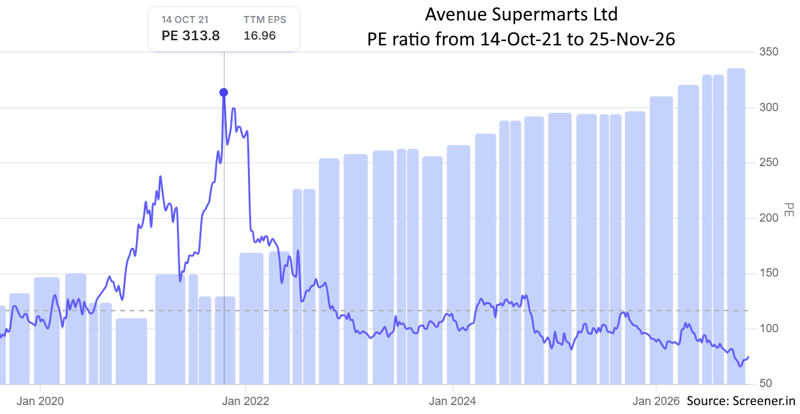
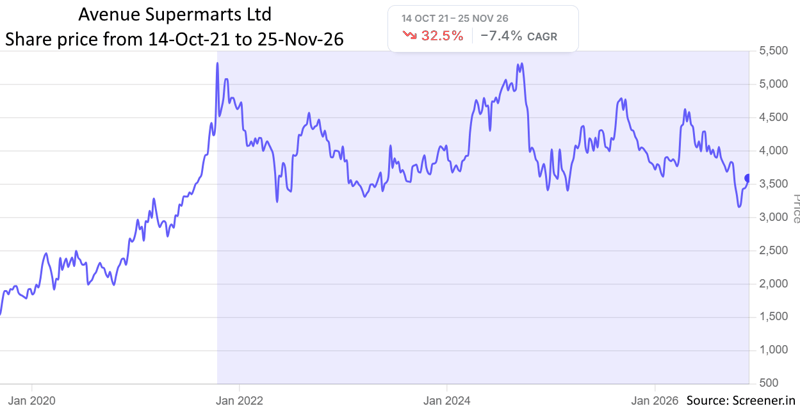
Because the P/E multiple fell so sharply, the share price moved from ₹5,323.75 on 14 October 2021 to ₹3,592/- on 25 November 2026, resulting in a decline of 32.5% at a CAGR of about -7.4% even as business earnings grew strongly.
Investors may also face negative surprises if, due to any reason, the management is not able to execute its plans, such as an absence of succession planning, infighting among the promoters or the next generation of the founding family, etc.
In addition, there are numerous other external factors that would influence the future returns of a stock, such as market sentiment, government reforms, political stability, macroeconomic policies, etc. Nobody can predict these external shocks in advance. Therefore, an investor needs protection in the form of a strong balance sheet and a reasonable purchase price rather than relying only on a good business story.
Taking a Complete View in Stock Analysis
Just like understanding the business is not sufficient for determining a good credit, in investing also, understanding the business is not sufficient for making an investment decision.
Therefore, an investor needs to take a comprehensive view by analysing additional aspects like management, valuation, and financial analysis, and doing proper risk management before she finally decides to invest her hard-earned money into any stock. She should focus on these areas alongside business analysis:
- Management analysis: Check the background of the promoters, their salaries, related party transactions, capital allocation record, and whether they have delivered on their past plans without hurting minority shareholders. (Read: How to do Management Analysis of Companies and How Promoters benefit from Related Party Transactions)
- Valuation analysis: Check whether the current stock price offers a healthy margin of safety, so that an unexpected slowdown in business growth or a fall in the P/E ratio does not wipe out years of returns. (Read: How to do Valuation Analysis of Companies and Margin of Safety in Stock Investing: A Complete Guide)
- Financial analysis: Study at least 10 years of financial data to check whether the company has converted its profits (PAT) into cash flow from operations (CFO), and kept its debt at manageable levels. (Read: How to do Financial Analysis of a Company)
- Risk and portfolio management: Avoid putting too much money into a single stock and monitor companies in her portfolio regularly, so that an unforeseen business or corporate governance issue does not permanently damage her overall wealth. (Read: How Many Stocks to Own in Your Portfolio? and How to Monitor Stocks in Your Portfolio)
Read: Final Checklist for Buying Stocks
Equity investing is an engrossing journey that demands a lot of time and effort from investors, and unfortunately, there is no shortcut for it.
At the same time, equity investing is so uncertain that even if an investor does everything right, her stocks may still not generate good returns for her. However, at the end of the day, this uncertainty and the underlying risk are what make good returns possible from stock investing.
Read: Dealing with Luck and Uncertainty in Stock Market Investing
Equity investing is supposed to be a roller-coaster ride, and we hope that we all stay safe on it and that the markets stay generous to us.
Regards,
Dr Vijay Malik
P.S.
- Subscribe to Dr Vijay Malik’s Recommended Stocks: Click here
- Bengaluru “Peaceful Investing” Workshop | 31 Jan 2027: Register Here
- To learn stock investing through videos, you may subscribe to the Peaceful Investing – Workshop Videos
- 25% savings on buying our Stock Analysis Excel Template and all ebooks together: Analysis Package: Excel Template + All eBooks (25% savings)
- To download our customized Stock Analysis Excel Template for analysing companies: Stock Analysis Excel
- Learn about our stock analysis approach in the e-book: “Peaceful Investing – A Simple Guide to Hassle-free Stock Investing”
- To learn how to do business analysis of companies: e-book: Business Analysis Guide
- To pre-register/express interest in a “Peaceful Investing” workshop in your city: Click here
Disclaimer
I, Vijay Malik, am a SEBI-registered Research Analyst (Regn. No. INH100008364). This article is for educational purposes only and does not constitute investment advice or a recommendation to buy or sell any securities. Investors should do their own research before making any investment decisions.
I, or my immediate relatives, do not have any financial interest in the companies discussed as on the date of publication of this article, nor do we hold one per cent or more of the securities of such companies at the end of the month immediately preceding it. I do not have any material conflict of interest and have not received any compensation or other benefits from the companies or any third party in relation to this article during the 12 months preceding its publication. I have not served as an officer, director, or employee of the subject companies, nor have I been engaged in market making activity for them.