Uncertainty is the only constant in stock investing.
There are so many things that influence companies’ performance and their stock price movements that, forget about understanding them, even listing out all these things can be difficult.
Companies and stocks are influenced by both factors within the companies as well as factors in the outside environment. On top of it, an investor’s own behaviour introduces another parameter that adds to uncertainty in stock returns.
Why Stock Investing Feels More Like Ludo Than Chess
A company may attempt to control whatever it can in its internal environment like employing the best people, giving them the best compensation and equipment, buying the best machines for manufacturing, locating its plants at the most suitable locations, and sourcing raw materials from the best suppliers at the cheapest prices. The company may deal with only the best distributors who take its products to every possible customer.
However, will such a utopian company generate the best returns for its shareholders? We are not sure. Why?
Because many times, the stock market behaves less like a strategic game of chess and more like a luck-based game of Ludo where the outcome of the roll of the dice is completely out of the company’s or the investor’s hands.
For instance, economic indicators like GDP growth, inflation rates, interest rates, employment generation, changes in regulations and government policies, natural disasters, geopolitical developments like wars, trade disputes, political instability, etc., can create big uncertainties in the markets. They can hurt a company’s business, its ability to get raw materials, trade and ship goods to its markets, and its ability to send employees to meet customers and develop business. Nobody knew that USA and Israel would attack Iran or that Russia would invade Ukraine and that the war would continue for years.
Technological advancements can disrupt entire industries and hurt the performance of companies. Until a few years ago, no one could think that Future Retail would become bankrupt, or that Nokia would become a historical name in mobile handsets. Similarly, what impact artificial intelligence tools like ChatGPT will have on Google, as well as our lives, remains uncertain.
Completely unforeseen events with a severe impact, called “black swans”, seem to be appearing more frequently. No one thought that even with all the medical advancements, we would see a pandemic like Covid in our lifetime, where all the businesses would be shut for a long time, everyone would become a captive at home, and we would fear coming near to another person. But that happened and has now gone past as well. What do we know is going to hit us a few years down the line?
Financial crises at global levels can hurt companies and stock markets around the world. The 2008 financial meltdown took down so many big and innumerable smaller companies with it. Since then, we have seen such crisis phases again and again, whether it was the Eurozone debt crisis, Brexit, the 2023 inflation and banking crisis taking down Credit Suisse, or India-specific problems like the IL&FS crisis blowing over the entire financial system or demonetization. We never know from which corner the next crisis will come and hurt companies’ businesses and shareholders’ returns.
And how can we forget investors’ sentiment? People’s emotions play a significant role in adding volatility to the markets. Extreme optimism leading to bull market tops and extreme pessimism making bear market bottoms are all emotion driven. In 2017-2018, only the sky was the limit for small caps’ prices and in February-March 2020, market prices knew no bottom. No one knows when the next phase of investors’ extreme fear or greed will hit the markets.
And what about the people running the companies? They are also human and to err is human. We may have done all the research, all the hard work, all the background checks, all the in-person management meetings, and all the reference checks. But how the promoter or the management will behave at any time is anybody’s guess. Someone who has always thought good about shareholders might one day turn into a selfish promoter, especially when the company suddenly gets a large amount of money, like the bumper performance of graphite electrodes in the past or the sale of business divisions by some companies. Someone who had never taken any poor business decision may do something that might destroy a long-standing established business. We never know.
Read: Why Management Assessment is the Most Critical Factor in Stock Investing?
And all these uncertain factors are always lurking around whether we acknowledge them or not. As someone said, “Stocks are NOT an FD with a higher return” (FD = Fixed Deposit of banks).
The Factors Outside Your Control: Understanding the Role of Luck
Equity investing requires a lot of time and effort from an investor to read about companies and understand their businesses, including all the annual reports and other publicly available documents. An investor who does her homework in analysis may expect to earn a good return in the markets.
However, out of all the factors affecting returns, the only factor under the control of the investor is the amount of time and effort that she is willing to put into her analysis of the company.
Beyond an investor’s own analysis, businesses and equity markets are affected by domestic government and central bank policies, and even by factors outside the Indian government’s control, like policies of central banks of other countries such as the US Fed. Any change in interest rates by foreign central banks changes the amount of money (liquidity) available to foreign investors to invest in India in both public markets as well as private markets. An easy availability of liquidity in the past had created so many unicorns (valuation of more than $1 billion, or around ₹9,300 crore), whereas later, when liquidity tightened, many of the same companies found it difficult to raise money.
Other ways foreign countries influence Indian businesses include promoting their exports by giving large incentives, which in turn leads to dumping of goods in India (very cheap imports). This has led to the closure of many small as well as large businesses in India.
Another big factor that determines an investor’s returns is the stock price, which is an outcome of the collective wisdom of all the investors in the market. Other investors may have their own reasons to be bullish or bearish. Investors’ sentiment is very volatile and fluctuates at the slightest changes in all the above-mentioned factors. Any change in liquidity, government actions, foreign investors’ actions, and foreign governments’ actions can lead to investors gaining or losing confidence. Then all the investors put together may buy or sell stocks in large amounts and move the markets.
All these factors outside our analysis, which are beyond an investor’s control, are labelled as “Luck“.
We understand that if we generated a good return on any stock in the past, then other factors, “Luck”, would have played a significant role and would continue to influence returns in the future.
Once you understand that not everything that controls the return from stock markets is under your control, then you will stop awarding or blaming yourself for your stocks’ performance. This is true for all investors, be it individuals, mutual funds, PMS, or other institutional investors.
After all, no one knows the future with certainty. Not even the promoters know for sure how the company will perform a few years down the line, what kind of competition it will face, what policy changes the government will make, and so on. History is full of such examples of poor capital allocation by promoters.
Why Equity Investing Is Still Better Than a Coin Toss
Even with all this uncertainty, keep in mind that equity investing is not purely a game of chance or a gamble like the toss of a coin or the throw of a dice. In equity investing, we have the benefit of history where the past is often linked to future performance. For example, there is a high probability that a talented, shareholder-friendly promoter will stay that way, a market-friendly government will bring in policies favourable to the industry, or a central bank will increase interest rates when inflation increases.
These higher probabilities of linkage of future actions with our historical knowledge make them better bets than a coin toss, where even if heads has come up for 99 previous times, the 100th toss would still have a 50:50 probability, unless the coin is rigged, of course.
However, even with higher probabilities, there is no certainty of things turning out as we expect.
Therefore, we believe that in the equity markets, we have taken out our small boat in an open sea, and now waves after waves of other outside factors (“Luck”) are hitting us and we do not know where we will end up eventually.
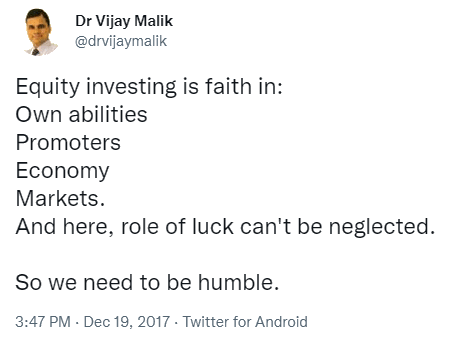
So, the best that we can do is to do our homework, i.e., analysis of present information, and then leave our fate to “Luck” (outside factors) to see if we make any money.
Making Decisions in Shades of Grey: Temporary Downturn vs. Permanent Damage
Because uncertainty and luck are always present, making actual buy, hold, or sell decisions in the stock market becomes very challenging. In fact, taking a sell decision is the most difficult aspect of any fundamental investor’s life.
When looking at stock prices, every up-move in the market may look like a profit-booking opportunity. Now, what should an investor do? Booking profits on every up-move takes away the opportunity to stay invested and create substantial wealth.
Every period of sideways movement may look like a lost opportunity of money lying idle.
Similarly, every downfall in the price may look like the initiation of a bear run, so the question of whether it is the best time to take the money out comes to mind. Selling on every small down-move again puts the investor out of the market when stocks might revive, as minor blips in stock price movements are an everyday norm.
Beyond stock prices, a company’s changing business performance creates similar challenges. Until the profits are increasing, there is usually little doubt in the investor’s mind. She is mostly happy that her decision to invest in the company is right. However, cases like Varanium Cloud Ltd and Add-Shop E-Retail Ltd indicate that an investor should be worried even when companies show bumper profits, because there might be a situation where there is no activity on the ground and a pump-and-dump scheme may be going on.
On the other hand, when business performance is going down, it might be a temporary blip where the company revives or turns around after a brief pause, which is the best buying opportunity. However, if it is a permanent decline where the competitors eat away its market share, then getting out of the stock as soon as one realizes that is the best decision.
However, here again, uncertainties raise their head. This is because if the changing business scenario is clear with major changes like the entry of Amazon or Reliance as competitors, then for investors, taking a decision becomes easy.
But as life and investing rarely give investors situations with easy decision-making, they are most frequently faced with gradually changing scenarios where things change not directly from white to black in an instant. Instead, they take on a gradual change from white to grey with hundreds of shades of grey before they become dark black.
Therefore, with a constant flow of new information and continuous reassessment of one’s position, the pendulum in the investor’s mind constantly fluctuates between determining a prospective successful turnaround situation or deciding that the turnaround will take ages or may not come at all.
Such times are the most taxing for the investor, especially when she has to decide about the future with full uncertainty around. As is famously said (often attributed to Niels Bohr or Yogi Berra), “Prediction is very difficult, especially about the future.”
Read: Can we Predict Future Performance of a Company?
How to Stay Calm and Rely on a Process during Uncertainty
How do we deal with it, the uncertainty all around? Just the way each one of us is living our lives, which have no less uncertainty than stock markets. We just keep doing our work and leave the rest in the hands of God (the stock market).
Our approach is to find good companies that have successfully dealt with past crises, that have shown good behaviour toward public shareholders, that have grown their business over the years and have dealt with numerous technological and political changes in the past, and that have the balance sheet strength to take some serious unexpected hits on the business and still keep standing on their feet to fight another day.
When we find such companies, then we make sure that we do not overpay for them.
Along with choosing financially strong companies at reasonable prices, what do we do when we are faced with uncertainties after we are already invested?
We find that in such times, having a process helps. The process, which also keeps evolving with time, helps an investor have some criteria and some guidelines to reassess the current uncertain situation.
The point to stress here is to stick with the process and take a decision when, as per your criteria, sufficient critical evidence to act has turned up. And when you sincerely believe and you are convinced that the time to change your view is here, then just change your view and make the decision without being emotional about it. Otherwise, investing and psychological biases will rear their head and start playing with your mind.
Now, whether the decisions will be right or wrong can only be judged in the future with the benefit of hindsight.
We all, as investors, will continue to face such uncertain situations forever in the market where making decisions will challenge all our acquired learning, question all our principles, doubt all our guidelines, and require huge mental effort. However, that is investing!
Further Reading:
- What is Peaceful Investing: Faith in the Promoter and Avoiding Permanent Loss of Capital
- Final Checklist for Buying Stocks
Regards,
Dr Vijay Malik
P.S.
- Subscribe to Dr Vijay Malik’s Recommended Stocks: Click here
- Bengaluru “Peaceful Investing” Workshop | 31 Jan 2027: Register Here
- To learn stock investing through videos, you may subscribe to the Peaceful Investing – Workshop Videos
- 25% savings on buying our Stock Analysis Excel Template and all ebooks together: Analysis Package: Excel Template + All eBooks (25% savings)
- To download our customized Stock Analysis Excel Template for analysing companies: Stock Analysis Excel
- Learn about our stock analysis approach in the e-book: “Peaceful Investing – A Simple Guide to Hassle-free Stock Investing”
- To learn how to do business analysis of companies: e-book: Business Analysis Guide
- To pre-register/express interest in a “Peaceful Investing” workshop in your city: Click here
Disclaimer
I, Vijay Malik, am a SEBI-registered Research Analyst (Regn. No. INH100008364). This article is for educational purposes only and does not constitute investment advice or a recommendation to buy or sell any securities. Investors should do their own research before making any investment decisions.
I, or my immediate relatives, do not have any financial interest in the companies discussed as on the date of publication of this article, nor do we hold one per cent or more of the securities of such companies at the end of the month immediately preceding it. I do not have any material conflict of interest and have not received any compensation or other benefits from the companies or any third party in relation to this article during the 12 months preceding its publication. I have not served as an officer, director, or employee of the subject companies, nor have I been engaged in market making activity for them.