HBL Engineering Ltd (formerly HBL Power Systems Ltd) is an Indian manufacturer of specialised industrial batteries, railway signalling electronics, and defence equipment. In recent years, the company has attracted significant investor interest and market attention following a sharp increase in its revenue and profitability, primarily driven by large orders for its Train Collision Avoidance System (TCAS), known as Kavach.
Our experience shows that during periods of improving business performance and strong market narratives, investors often overlook and underestimate key risks that can become critical from a long-term perspective. As a result, the current article focuses on several underlying aspects of HBL Engineering Ltd that a long-term investor should examine closely before forming an opinion about the company.
Please note that this analysis is not intended to arrive at a buy or sell conclusion. Instead, it aims to highlight fundamental factors, structural industry shifts, capital allocation patterns, and corporate governance aspects that investors tend to ignore during periods of high reported growth.
Key Aspects Long-Term Investors Should Examine Carefully
A snapshot of the financial performance of HBL Engineering Ltd over the last 10 years is provided below to give you the context for the discussion that follows:
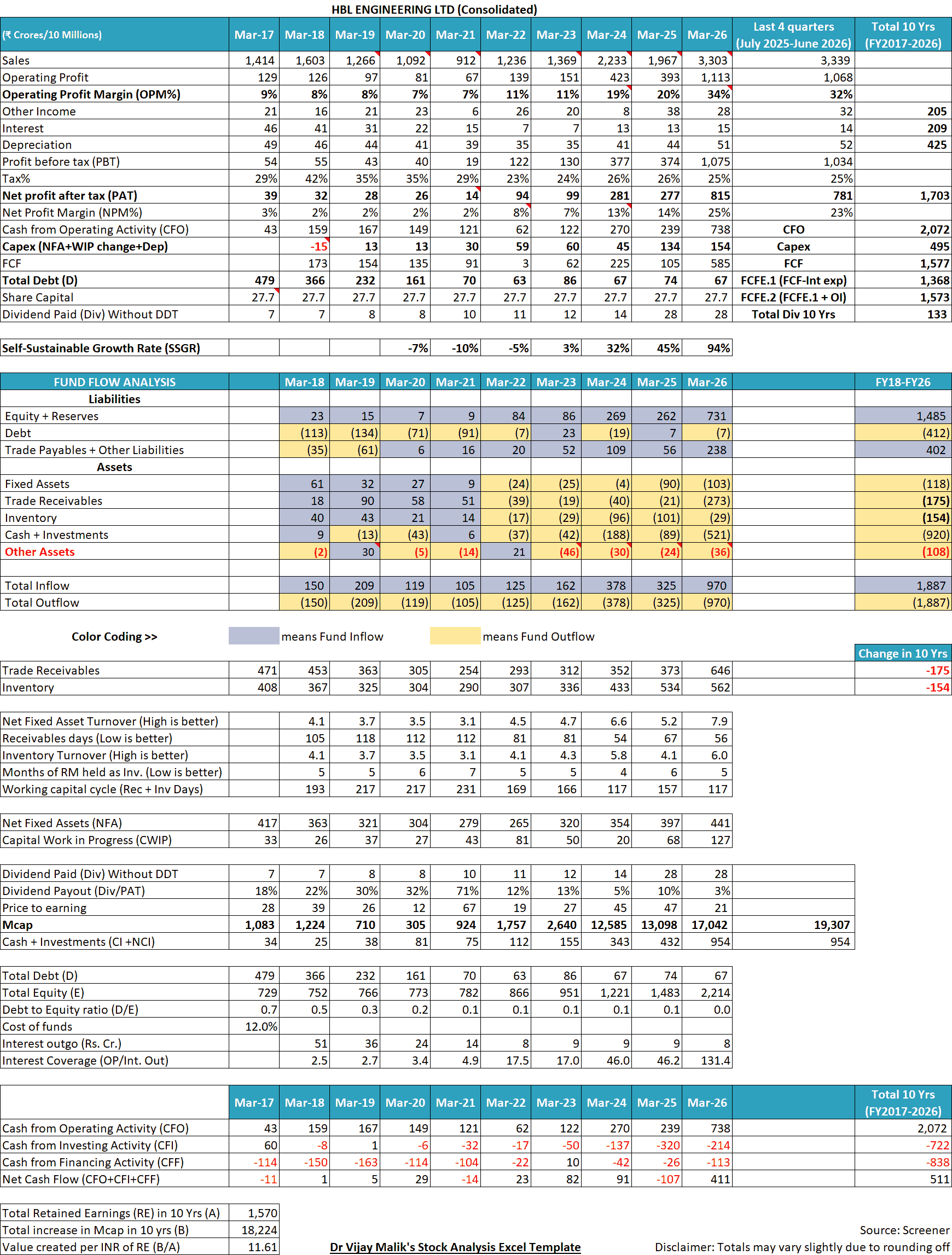
1) Shrinking of Core Battery Business and Disruption from Lithium-Ion
For several decades, industrial batteries were the major revenue source for HBL Engineering Ltd. The company built strong market positions in lead-acid batteries, mainly Valve Regulated Lead-Acid (VRLA), and Nickel-Cadmium (Ni-Cd) batteries for telecom towers, railways, and power utilities, among others. However, rapid technological changes and steep cost reductions in Lithium-ion batteries are now fundamentally changing the battery industry.
1.1 Shift of Major Customer Segments from VRLA and Ni-Cd to Lithium-Ion
Over the last few years, the price of Lithium-ion cells has fallen sharply. This price decline has made Lithium-ion batteries economically competitive with traditional industrial VRLA and Ni-Cd batteries on a total cost of ownership basis. Key user segments such as telecom towers, data centres, commercial uninterruptible power supply (UPS) systems, and railway coaches are increasingly transitioning away from lead-acid technology toward Lithium-ion solutions.
In the telecom tower sector, which historically formed the largest business segment for HBL Engineering Ltd, major tower operators and public-sector entities like BSNL have shifted toward large-scale deployment of Lithium-ion batteries. In response to this permanent reduction in demand, the company has had to reduce its 2V-VRLA manufacturing capacity, which was primarily used for the telecom business.
As stated in the Annual Report (AR) for FY2025, P10:
Lithium-Ion cells are now price competitive with industrial VRLA lead batteries, and it is matter of time before industrial VRLA lead batteries are replaced with LIB, by all big customers. VRLA will coexist, but not in all prime markets.
This shift indicates that the core battery business of HBL Engineering Ltd is facing structural volume shrinkage. When a company’s main product line undergoes technological disruption, its historical revenue stability cannot be taken for granted.
1.2 HBL’s Absence from Lithium-Ion Cell Manufacturing and Pricing Pressure from Large Competitors
While the domestic battery industry is transitioning toward Lithium-ion, HBL Engineering Ltd has explicitly decided not to enter the manufacturing of Lithium-ion cells. The management sees Li-Ion cell manufacturing as a highly commoditised, capital-intensive business dominated by Chinese suppliers. Instead, the company has limited its role to low-volume, specialised pack assembly using imported cells, along with small pilot facilities dedicated strictly to defence applications.
In contrast, large organised competitors such as Exide Industries and Amara Raja Energy & Mobility are setting up large Lithium-ion cell manufacturing facilities. Once these mega-factories start production, the domestic supply of Lithium-ion cells will increase substantially. This domestic supply is likely to drive Li-Ion battery prices down even further, increasing the pace of replacement of older lead-acid and Ni-Cd chemistries across sectors.
The management clearly laid out this divergence in its strategy in the Annual Report for FY2025, P10:
Both of India’s leading automotive lead battery companies and several other ambitious Indian companies, have committed to invest large capex to make Lithium-Ion cells. HBL will not enter capital intensive businesses. Instead, we will focus on low volume, customized, engineering intensive higher margin markets for LIB.
This highlights a significant underlying risk. By avoiding the heavy capital expenditure of cell manufacturing, HBL protects its balance sheet today. However, by relying entirely on imports and staying out of mass-market Lithium-ion production, the company leaves its primary legacy revenue segment exposed to the aggressive pricing power of larger domestic rivals.
1.3 High Cyclicality and Low Pricing Power in Legacy Segments like Telecom
The history of HBL Engineering Ltd demonstrates that its legacy battery business has always operated with limited pricing power and high customer concentration. The telecom industry, which has been its largest customer, has historically gone through severe cyclical downturns and consolidation phases. During these periods, tower companies and operators slowed down their capital expenditure and put extreme pricing pressure on their suppliers like HBL.
Raw materials, mainly lead, account for about 50% to 60% of the cost of batteries. Whenever raw material prices increased during an industry downcycle, HBL Engineering Ltd was unable to pass on these input costs to powerful telecom buyers.
For example, during FY2011, a collapse in telecom battery demand and rising lead prices caused the company’s net profit after tax (PAT) to decline by 85%, leading to an operating loss in FY2014 and contributing to five consecutive years of declining profits from FY2017 to FY2021.
Credit rating reports (CR) have repeatedly highlighted this vulnerability. As noted in the CR by CARE in August 2019, P2:
The telecom segment, which accounted for 33.72% of HBL’s revenue during FY19, has been going through a tough consolidation phase, wherein the telecom operators/ infrastructure players continue to exert pressure on vendors to reduce prices.
The company itself described the difficult economics of this segment in its AR2021, P18:
Adverse changes in telecom sectoral dynamics resulted in irrational competition which have dampened the prospects of the telecom sector drastically. Sharp cost rationalization strategies by telecom players and increased competition in telecom battery supplies have resulted in undesirable battery pricing, making this business unattractive for HBL from a Return on Resources used perspective.
This track record illustrates an important fundamental principle: when a business supplies commodity-like industrial components to large, concentrated buyers, its profit margins remain at the mercy of industry cycles. For HBL Engineering Ltd, the decline in telecom battery volumes, combined with an absence of pricing power, means this legacy segment cannot be relied upon to provide a stable earnings floor during future downturns.
Also read: How to do business analysis of any company
2) Kavach and Railway Signalling: A Limited-Time Opportunity Facing Multiple Headwinds
In recent years, the primary reason behind the sharp increase in the financial performance and share price of HBL Engineering Ltd has been its railway electronics division, particularly the Train Collision Avoidance System (TCAS), known as Kavach. The market seems to treat this development as a long-term structural growth driver. However, a deeper look at the business dynamics of railway procurement, contract execution, and technology life cycles highlights several critical risks.
2.1 Government Multi-Vendor Policies and Dilution of First-Mover Advantage
HBL Engineering Ltd began the development of its anti-collision signalling technology in 2005. It took nearly 15 to 20 years of research, field trials, and safety evaluations with the Research Designs and Standards Organisation (RDSO) before it received large commercial orders. However, in government procurement, being the pioneer does not grant a permanent monopoly.
The Indian Railways follows a mandatory policy of developing multiple suppliers for every critical technology to prevent dependence on a single vendor and to keep its procurement prices down. As a result, the intellectual property and patents for the Kavach system were jointly held with RDSO. Once the initial development succeeded, the government invited more suppliers to participate in the Kavach program.
As disclosed by the management in the Concall of July 2024, P21:
patents of the TCAS system are owned by RDSO and jointly by, you know, HBL and some of these other companies
Over the years, the number of approved Kavach Original Equipment Manufacturers (OEMs) grew from three initial vendors to five. Based on recent public tenders and industry data, more than 10 to 12 engineering and electronic manufacturing service (EMS) companies, including players like Kaynes Technology, Avalon Technologies, Quadrant Future Tek, and GG Tronics, have entered the field. With more vendors qualifying for new tenders, the target order book/overall revenue from Kavach is continuously getting divided between a larger number of suppliers.
The Print: Railways needs more players to install ‘Kavach’ on entire network in 5 years: Concord
This open, multi-vendor environment quickly turns high-tech engineering into price-competitive bidding. In January 2026, when Chittaranjan Locomotive Works (CLW) decided a major tender for 6,300 locomotive Kavach units, HBL Engineering Ltd did not win any order because other bidders quoted lower prices (Exchange Disclosure, January 15, 2026).
This outcome demonstrates a key reality of public procurement. While an early entrant bears the multi-decade research and development expenses, government buyers introduce competition as soon as the technology matures, thereby diluting any early-mover advantage.
2.2 Revenue Plateau Beyond FY2028 and the Small Market Size of Alternate Systems like TMS
The increase in Kavach execution has provided strong revenue visibility for the immediate term. However, this is largely a front-loaded revenue generation rather than an evergreen source of long-term business. Management itself has said that the high-volume phase of Kavach installations will reach a plateau within two to three years and may begin to decline after FY2028.
In the Annual Report for FY2025, P5, the company highlighted this aspect:
Rail Signaling would be the single largest business during the period to FY30. Kavach sales should be steady at about ₹1,300 – ₹1,500 crs per year during FY 26, FY27, FY28. Later they should dip.
To offset the anticipated slowdown in Kavach sales beyond FY2028, the company has pointed toward other railway signalling products, such as Train Management Systems (TMS) and Centralised Train Control (CTC). However, the total addressable market size of TMS in India is significantly smaller compared to network-wide anti-collision systems.
As the company explained in its FY2025 Annual Report, P18:
value of business is small; at most ₹200 crore per year. A typical price per system would be ₹50 crore, depending on what else is included in the scope of a tender.
An addressable market of around ₹200 crore per year across the entire country cannot compensate for the potential drop in revenue when multi-thousand-crore Kavach contracts slow down.
During the AGM of September 25, 2025, P2, the promoter acknowledged this visibility gap beyond the next few years:
So, overall, the visibility for the next three years exists. And beyond that, you have to take my word for it because a lot of developments I do not want to talk about unless there is something firm on the ground.
The risk here is clear. When a company’s largest profit driver has an expiration timeline, long-term sustainability depends entirely on whether unproven future products can commercialise in time. Relying on promoter assurances without concrete revenue visibility introduces significant uncertainty and risk.
2.3 Project Execution Challenges, Tender Exclusions, and Order Cancellations
Working on government railway signalling projects involves tight delivery schedules, complex site coordination, and strict penalty clauses. In the past, HBL Engineering Ltd has struggled with project timelines, leading to liquidated damages and lost opportunities.
For instance, in AR2010, P32, the company admitted that deficiencies in project execution cost it significant time:
The company’s project management competence has not been up to the mark. It is acknowledged that this deficiency has cost us two years of time in getting qualification for the Electronic Interlocking System (EIS) project.
Similar execution bottlenecks have surfaced in the ongoing Kavach rollout. In December 2024, the company received an order from Chittaranjan Locomotive Works (CLW) to supply and install onboard Kavach units in 2,200 locomotives within 12 months.
However, due to execution constraints, HBL Engineering Ltd was able to deliver only 1,659 units (about 75.4%) by the December 13, 2025 deadline. Under the strict terms of the purchase order, the balance of 541 undelivered units was cancelled by the customer (Exchange Disclosure, December 18, 2025).
Furthermore, quarterly results show extreme volatility in performance depending on milestone completions and tender timings. After peaking in Q2-FY2026, the company’s sales and net profit after tax experienced sharp consecutive declines in Q3-FY2026 and Q4-FY2026 as the railway electronics business slowed down.
These instances show that supplying complex electronics to public sector organisations involves significant operational and execution risks. When project execution fails, unfulfilled orders may be cancelled rather than extended, leading to sudden volatility in financial results.
3) High Uncertainty, Long Gestation, and External Control in B2G and Defence Businesses
The strong point for the investment thesis for HBL Engineering Ltd is said to be its presence in critical engineering applications for Indian Railways and the Defence forces.
While these sectors offer large business opportunities, they operate as Business-to-Government (B2G) markets. In B2G businesses, the buying process is governed by bureaucratic decision-making, shifting political priorities, complex qualification procedures, and rigid procurement rules.
For long-term investors, understanding the unique risks of supplying to government institutions is essential to assess whether any company’s reported order book can result in stable and profitable growth.
3.1 Long-delayed Development Cycles and Government Policy Shifts
Developing products for defence and railways requires patience and substantial capital. At HBL Engineering Ltd, the timeline from initial product design to revenue has often been more than a decade. During these extended developmental periods, companies bear all the development costs while waiting for government agencies to conduct field trials, finalise technical specifications, and issue tenders.
For example, HBL began working on railway Electronic Interlocking Systems (EIS) in 2003, but the product took over a decade just to reach testing stages. Similarly, work on electronic artillery fuzes began around 2006 and required nearly two decades of development.
HBL highlighted this long gestation aspect in the Annual Report for FY2025, P5:
The ‘conception to profit’ timeline has averaged 15 years. (Kavach took 20 years).
Even when a technology is successfully developed, procurement can stop entirely if government departments change their project priorities or delay issuing tenders.
Between February 2022 and August 2024, Indian Railways did not issue any major new Kavach tenders because technical specifications were revised from Version 3.2 to Version 4.0, leading to a temporary slowdown in orders.
In the past, these long gestation cycles combined with delayed government orders severely strained the finances of HBL Engineering Ltd. As disclosed in AR2015, P39:
Demand for Rail Signaling and Defence Projects, on which large investments were made, did not materialize at all. Term debt, used to finance this, led to severe stress on cash flow, with resulting problems which are commonly known.
Furthermore, sudden changes in regulatory policies can introduce unexpected costs. For instance, in FY2025, the introduction of new Extended Producer Responsibility (EPR) regulations for battery recycling forced HBL Engineering Ltd to create provisions of ₹13.60 crore for recycling obligations and certificate purchases (AR2025, P264-265).
Extended development cycles place an engineering company in a highly risky position. When money is tied up for 10 to 15 years in developmental products, any change in government administration, leadership priorities, or regulatory norms can delay cash flows and erode returns on invested capital.
3.2 Pressures to Share Technology and Preference for Public Sector Undertakings
In government procurement, developing an advanced product does not guarantee that a private company will receive the manufacturing orders. Government agencies regularly favour Public Sector Undertakings (PSUs) or require private innovators to share their proprietary technology with other suppliers to ensure multiple suppliers.
HBL Engineering Ltd has faced this situation in its defence business. The company spent nearly two decades developing electronic fuzes and reserve batteries for artillery ammunition. However, when large procurement requirements came up, the government gave orders to the PSU Bharat Electronics Limited (BEL).
Moreover, defence authorities encouraged HBL Engineering Ltd to supply its specialised batteries to BEL rather than giving it the complete weapon component contracts.
The promoter detailed these commercial pressures during the AGM of September 25, 2025, P12:
the army itself asked us, why don’t you sell your batteries to BEL?… So people are trying to put pressure…well, okay, we were aware of this device for a long time and when we wanted to talk, nobody was interested.
The promoter also noted in the same meeting that ammunition fuzes operate with limited pricing power because defence buyers purchase in large volumes and actively seek multiple vendors (AGM Transcript, September 25, 2025, P14).
This highlights a critical reality of the B2G segment, where government buyers hold absolute purchasing power. A private vendor like HBL Engineering Ltd can invest years of effort in research, only to find that public sector companies receive preferred treatment, or that customer authorities mandate multi-vendor sourcing to keep procurement prices low.
3.3 Commercialisation Challenges in Certified Products like Aircraft Batteries
A common misconception among investors is that obtaining stringent technical approvals automatically leads to commercial sales.
In global industries such as aerospace, commercial acceptance depends heavily on existing supply chain relationships, approval by aircraft manufacturers, and insurance preferences.
HBL Engineering Ltd received technical certifications from international aviation regulators, including the Federal Aviation Administration (FAA) in the United States and the European Union Aviation Safety Agency (EASA), for its aircraft batteries for Boeing 737 and Airbus A320. However, despite getting these approvals, it could not sell to Boeing and Airbus.
The company explained this problem in its Investor Presentation of February 2023, P20:
FAA and EASA had certified HBL batteries as acceptable for Boeing 737 and Airbus 320 series of aircraft. But sales have not yet occurred, because companies insuring aircraft want OEM’s to approve the batteries used. However, OEMs are indifferent to the cost saving by buying from HBL.
This is not an isolated incident. Earlier in the railway division, HBL Engineering Ltd developed Train Actuated Warning Systems for unmanned level crossing gates. While the technology was successfully built, commercial demand failed to materialise because the Railway’s purchasing priorities shifted (AR2010, P32).
Technical success in research and development is only half the battle. If global OEMs find no incentive to switch suppliers, or if insurance and warranty conditions favour existing suppliers, then even high-tech certifications do not generate revenue. Investors must therefore differentiate between technical capability and commercial viability.
4) Capital Allocation Track Record: Failed Diversifications and Developmental Write-Offs
Long-term investors should always assess how management deploys surplus capital. For HBL Engineering Ltd, a review of its capital allocation history reveals a persistent pattern of failed overseas diversifications, domestic subsidiary closures, and large developmental write-offs that have frequently destroyed shareholder value.
4.1 History of Failed Overseas Ventures and Subsidiary Closures
Over the years, HBL Engineering Ltd tried to expand its geographical reach as well as product portfolio by establishing numerous subsidiaries and joint ventures (JVs). However, a majority of these ventures have failed, leading to financial losses and eventual closures.
For example, the company set up a 100% subsidiary in Nepal (Bhagirath Energy Systems Ltd) to process components, but it became unviable and was closed at a loss (AR2004, P30). A Joint Venture in South Korea, Rocket HBL Ltd, failed due to severe competition, leading the company to write off an initial investment of ₹1.49 crore and make provisions for ₹1.89 crore of unrealised sales (AR2002, P33). Although a partial recovery was made later, it still resulted in a net loss (AR2003, P9).
Similar outcomes were seen in the UK, where HBL (UK) Ltd was liquidated after a trademark violation lawsuit that restrained the company from using the “NIFE” brand (AR2006, P44; AR2010, P10). A Malaysian venture started in FY2005 but was entirely divested by FY2012 (AR2012, P19).
In the Middle East, the company invested over ₹14 crore for a 40% stake in Gulf Batteries Company Ltd in Saudi Arabia. However, after years of underperformance and accumulated losses eroding 75% of its capital, HBL’s shareholding in the JV was finally transferred for a mere ₹5.05 lakh in FY2022 (AR2019, P34; AR2022, P48).
Within India also, HBL has shown a similar pattern of exiting non-core investments. It acquired and later disinvested stakes in Autotec Systems and Sankhya Infotech, and its investment in SCIL Infracon was fully written off following labour unrest and prolonged legal disputes with former promoters (AR2014, P13; AR2019, P154).
The management accepted the damages done by these non-core ventures. As stated in AR2015, P39:
The company’s efforts to grow by strategic investments in other businesses were, as a group, profitable; but the cost of management being thus distracted was also high. In retrospect, the net impact was negative.
Despite this admission, recent capital allocation decisions of HBL indicate that it might be going back to similar distracting investments, prioritising unrelated equity stakes over core operational focus.
4.2 Large R&D Write-Offs in Electric Trucks and Torpedo Batteries
In addition to failed subsidiaries, HBL Engineering Ltd has committed significant capital to long-gestation research and development (R&D) projects that have sometimes ended in complete write-offs.
HBL’s entry into electric mobility is one such example. Since 2017, the company had been investing money in developing electric drive trains to convert old diesel commercial vehicles into electric. However, after years of effort and trials, the company realised the retrofit model for light commercial vehicles was economically unviable.
Then, it abruptly changed its strategy to making new 35-ton and 55-ton electric trucks and operating as an Original Equipment Manufacturer (OEM), an area where it has no prior vehicle manufacturing expertise (AR2025, P14). This strategic failure led to a massive write-off of intangible assets, resulting in a ₹26.96 crore expense (AR2024, P225; Concall July 2024, P28).
Similarly, in its defence segment, HBL spent years developing high-performance batteries for torpedoes. In FY2026, the company had to recognise unrecoverable costs incurred during this development, leading to write-offs of ₹26.49 crore in FY2026 (Q4-FY2026, P18).
These instances highlight the high-risk nature of the company’s business model. When a company acts as a venture incubator for unproven engineering projects, shareholders’ equity is exposed to the risk of total loss if the product fails to commercialise or the strategy changes.
4.3 Capital Misallocation in Third-Party Alternative Investment Funds (AIFs) and Non-Core Assets
Recently, the increase in revenue from Kavach orders has generated significant cash surpluses for the company. However, rather than strengthening its balance sheet or distributing excess cash to shareholders, the management is putting this capital into third-party Alternative Investment Funds (AIFs) and non-core “start-up” equity.
In FY2025, the company invested ₹20 crore into units of the India SME Investment Fund-II, a Category 2 AIF (AR2025, P173). Furthermore, the company announced the establishment of Mittelstand Technology Partners, its own Category 2 AIF, to make private-equity-style investments in other technology-driven companies (AR2025, P7).
Alongside these fund structures, the company has been making direct equity investments and loans to various start-ups. It invested ₹86.67 crore in Tonbo Imaging India Pvt Ltd (AR2024, P150) and has recently approved further investments into start-ups like Yaanendriya Private Limited and Xalten Systems (Q3-FY2026, P1).
In another instance, it invested ₹1.2 crore in equity and provided a ₹2.2 crore loan to TTL Electric Fuel Private Limited, only to recognise a 50% diminution in the equity value within the same reporting period (AR2025, P172).
Investing core business cash flows into illiquid AIFs and external start-ups represents a significant capital misallocation risk. AIF commitments are binding, long-term contracts that require the company to provide money upon capital calls. If HBL Engineering Ltd faces a sudden downcycle in its core battery or railway signalling business, which has happened multiple times in the past, then it could face severe liquidity stress while attempting to meet these illiquid investment commitments.
Investors must critically analyse such capital allocation behaviour. When a manufacturing company diverts peak-cycle earnings into venture capital funds and unrelated start-ups, it increases the overall risk profile of the business and reduces the cash available to handle future operational downturns.
Also read: How to Identify if Management is Misallocating Capital
5) Corporate Governance Concerns, High Remuneration, and Institutional Dissent
For a long-term investor, assessing corporate governance should go beyond merely checking regulatory compliance. It should include checking the alignment of promoters’ interests with those of minority shareholders.
At HBL Engineering Ltd, a history of compliance lapses, high promoter compensation, and institutional dissent during AGM voting presents several red flags that warrant careful consideration.
5.1 High Promoter Commission and Heavy Voting Dissent by Institutional Shareholders
Promoter remuneration is a key parameter to check how value is shared between management and public shareholders. At HBL Engineering Ltd, the promoter and Chairman and Managing Director (CMD), Dr. A. J. Prasad, receives a large commission tied to the company’s profits.
In FY2025, his total remuneration stood at approximately ₹20 crore, which included a fixed salary of ₹1.03 crore and a massive profit-linked commission of ₹18.95 crore, representing 5% of the company’s net profits (AR2025, P52).
While profit-linked commissions are legally allowed, taking such a large absolute payout during a temporary, cyclical surge in government (Kavach) orders often raises concerns among conservative investors.
This aggressive extraction of cash via remuneration has not gone unnoticed by institutional shareholders, who have expressed strong dissatisfaction with the management. During the Annual General Meeting (AGM) held on September 25, 2025, a resolution was proposed to reappoint Dr. A. J. Prasad as CMD for another five years. The voting results revealed significant institutional distrust: approximately 37.88% of public institutional shareholders voted against his reappointment. (AGM Voting Results, September 2025, P16).
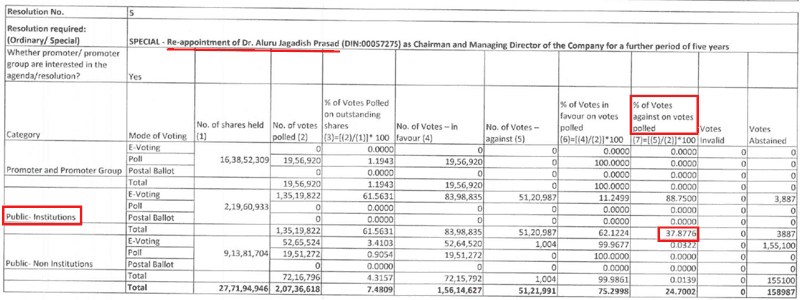
Substantial dissent from institutional investors is a warning sign. When major capital providers vote against the promoter’s reappointment and compensation structure, it reflects an underlying concern regarding the alignment of management incentives with minority shareholder interests.
Also read: How to identify Promoters extracting Money via High Salaries
5.2 Compliance Lapses, Trademark Injunctions, and Unresolved Arbitration Disputes
The governance culture at HBL Engineering Ltd has also been marked by historical compliance lapses, legal disputes, and ethical issues within its subsidiaries.
In the past, the company continued to use the trademark “NIFE” long after its technical collaboration agreement had ended. This practice only stopped after the brand’s owner (SAFT) initiated legal action, resulting in a UK court passing an order against the company’s UK subsidiary for trademark violation (AR2006, P8, P44).
In another instance, HBL had to report disruptions and financial losses in its German subsidiary due to the “unethical behaviour” of the local Managing Director, indicating weak internal controls over overseas operations (AR2014, P13).
Within India, HBL has been engaged in prolonged arbitration and legal disputes. After its investment in SCIL Infracon, HBL Engineering Ltd faced a prolonged legal battle with SCIL’s former promoters over unpaid consideration. Finally, an arbitrator ruled against HBL, forcing the company to deposit 50% of the award amount (over ₹2.7 crore) while the matter remains sub judice (AR2023, P222; AR2025, P206).
Furthermore, the company has faced regulatory penalties. In FY2024, the Reserve Bank of India levied a penalty on the company’s erstwhile holding entity for delayed Foreign Direct Investment (FDI) reporting under FEMA regulations, and the state pollution control board imposed a fine for the unauthorised disposal of hazardous waste (AR2024, P66).
A recurring pattern of trademark injunctions, arbitration awards, and regulatory penalties points toward structural weaknesses in compliance and governance. Investors should factor in these legal and governance risks, as they can suddenly destroy shareholder value.
5.3 Historical Reliance on External Funding and Loan Diversions
Before the recent windfall from Kavach orders, the core operations of HBL Engineering Ltd were highly cash-consumptive, forcing the company to rely continuously on external funding.
Throughout its history, the company sustained its operations through preferential equity allotments (2006, 2010), rights issues (2005), and interest-free loans from its promoter holding company (AR2013, P7; AR2014, P7).
More concerning, however, is how the company managed its debt during periods of financial stress. Statutory auditors have repeatedly flagged the diversion of borrowed funds.
For instance, in FY2009, auditors noted that a ₹16 crore term loan was applied for non-sanctioned purposes (AR2009, P13). This pattern continued in FY2011, when ₹90 crore of loans were used for non-sanctioned purposes, and ₹102 crore of short-term funds were diverted for long-term uses (AR2011, P68). Similar diversions of short-term loans for long-term equity investments were observed in subsequent years (AR2012, P60).
When a company diverts bank loans away from their sanctioned purposes, it breaches the fundamental trust of its lenders and highlights severe internal liquidity pressures. While the company’s cash flows have temporarily improved due to the large Kavach orders from Railways, this historical track record of loan diversion and constant equity dilution illustrates the structural financial weakness of its business model.
Investors must recognise that once the current Kavach orders slow down, the company’s underlying cash-consuming nature may reappear, which might lead to a return of debt stress and reliance on external funding.
Conclusion: Learning for Long-Term Investors
The analysis of HBL Engineering Ltd highlights how a sudden improvement in reported performance, driven by a specific government policy, can hide deep structural challenges.
While HBL is currently enjoying the limelight of the Kavach orders, its traditional bread-and-butter business of VRLA and Ni-Cd batteries is continuously shrinking. The continuous price reduction of Lithium-ion batteries is pushing its large customers away, permanently threatening the core business of the company.
Moreover, the Kavach opportunity is already losing its shine. It is a limited-time windfall where the railway authorities are continuously dividing the orders among more suppliers. With newer competitors aggressively quoting lower prices and pushing HBL out of recent tender allotments, the peak of this business seems temporary. Management itself has indicated that Kavach sales will start falling beyond FY2028. Alternative products, such as Train Management Systems, are too small in market size to compensate for this upcoming decline.
Beyond Kavach, none of the company’s other new initiatives provides clear revenue visibility. The company has suffered large capital write-offs in unproven developmental projects, like electric trucks and torpedo batteries.
Historically, HBL relied heavily on external capital to sustain its operations through tough times. Now, when it is finally generating surplus cash from the Kavach orders, the management is putting this money into third-party Alternative Investment Funds, which might turn out to be a poor and illiquid use of shareholder wealth.
These strategic missteps are compounded by corporate governance concerns. The promoter is taking a very high salary and commission payouts while asking investors to simply trust his word for future growth. This approach has led to a loss of faith among institutional investors, resulting in them voting in large numbers against his reappointment as CMD during the FY2025 AGM.
For long-term investors, the key learning is to look beyond the current euphoria and understand the difficult nature of the underlying business. HBL Engineering Ltd operates in an intensely competitive segment against unorganised, domestic, and foreign players, with the added complications of supplying to rigid government organisations like railways and defence.
Despite its advertised vision and values, the company spent long periods in the past delivering poor performance and even landing in operating losses. Once the temporary Kavach opportunity slows down, the company runs a high risk of reverting to its old patterns of financial struggle.
As a result, investors should do a deeper analysis before making any investment decision about the company because sustainable wealth creation in stock markets requires learning to separate a temporary, cyclical windfall from a durable, self-sustaining business model.
In our premium services, this kind of analysis is used primarily as a filtering tool to eliminate businesses where long-term risks outweigh the benefits of growth. Only companies that demonstrate sustainable cash flows, prudent capital allocation, and aligned promoter incentives eventually qualify for inclusion in my long-term portfolio.
Regards,
Dr Vijay Malik
P.S.
- Subscribe to Dr Vijay Malik’s Recommended Stocks: Click here
- Bengaluru “Peaceful Investing” Workshop | 31 Jan 2027: Register Here
- To learn stock investing through videos, you may subscribe to the Peaceful Investing – Workshop Videos
- 25% savings on buying our Stock Analysis Excel Template and all ebooks together: Analysis Package: Excel Template + All eBooks (25% savings)
- To download our customized Stock Analysis Excel Template for analysing companies: Stock Analysis Excel
- Learn about our stock analysis approach in the e-book: “Peaceful Investing – A Simple Guide to Hassle-free Stock Investing”
- To learn how to do business analysis of companies: e-book: Business Analysis Guide
- To pre-register/express interest in a “Peaceful Investing” workshop in your city: Click here
Disclaimer
I, Vijay Malik, am a SEBI-registered Research Analyst (Regn. No. INH100008364). This article is for educational purposes only and does not constitute investment advice or a recommendation to buy or sell any securities. Investors should do their own research before making any investment decisions.
I, or my immediate relatives, do not have any financial interest in the companies discussed as on the date of publication of this article, nor do we hold one per cent or more of the securities of such companies at the end of the month immediately preceding it. I do not have any material conflict of interest and have not received any compensation or other benefits from the companies or any third party in relation to this article during the 12 months preceding its publication. I have not served as an officer, director, or employee of the subject companies, nor have I been engaged in market making activity for them.


2 thoughts on “HBL Engineering Ltd: Long-Term Risks, Kavach & Beyond”
I read with interest ” Analysis of HBL Engg.It is surprising that the Engg Company is not in envious position to recover the invetment of developing tech products when it comes to cmmercial applications as the user departments do not guarantee orders and do not dderecognise as exclusive OEM.Further tech disrptions due to obsolence of acid and Ni–Cd batteries yielding place to Lithium ion betteres is anothher threat to business continuity .
Hi T Sri Krishna,
You have summarised two critical fundamental risks very well.
In government-driven B2G contracts, developing a technology does not provide a permanent monopoly or assured margins because the buyer enforces multiple suppliers to keep procurement prices low. At the same time, when a company’s historical core product faces technological disruption from cheaper alternatives like Lithium-ion, a decline in sales volume becomes a serious challenge.
All the best for your investing journey!
Regards,
Dr Vijay Malik