Many investors ask us what kind of returns we expect to make from the stock market. This question comes in different formats, such as what is the minimum return that stocks can generate if one stays invested for a decade, or if one buys some stocks and forgets them for the rest of her life, how much return they can generate.
We also get queries like “how can I make my portfolio 100x in 5 years” or “my friends are making 5% return per month by selling options; can I match their performance?”
Some young investors also wonder, “How soon can we quit our jobs and retire by living on earnings from stock markets? We see so many young people on social media living lavish lives based on earnings from stock markets.”
Such queries represent a desire from investors to make large amounts of money quickly from the markets and, at times, reflect an expectation to find a sure-shot strategy which, if put on autopilot mode in the stock market, can keep on making money every day that investors can live off without worrying about the stresses of jobs or entrepreneurship.
The Dangerous Fantasy of Quick and Guaranteed Stock Market Returns
Over the years, the Indian stock market regulator, the Securities and Exchange Board of India (SEBI), has started a strict movement against many entities, advisers, and finfluencers that, as per SEBI, have promised assured, guaranteed, and high returns to their subscribers and investors.
SEBI chairperson said that:
(They say that) if you trade, you will earn in lakhs and crores. You will become crorepati in two years. They already say that you can make lakhs every day. This is inducement. Those who are genuine experts know that nothing of that sort happens in the market. There is no guarantee. Even Warren Buffett makes losses.
SEBI has also walked the talk and has acted against many entities in this regard. Take, for example, SEBI’s October 2026 final order against Avadhut Sathe and Avadhut Sathe Trading Academy Private Limited, where SEBI barred them from the securities market for two years and ordered a refund of ₹546.17 crore to investors and course participants, along with interest (₹67.87 cr) and penalties (₹11.5 cr). SEBI found that they were “disseminating misleading information and advertisements through social media platforms, aimed at inducing investors by portraying unrealistic returns from stock market activities“. SEBI also noted that while the academy claimed that its trainers and participants consistently made profits, its analysis showed that they were actually in net losses.
If one takes even a cursory look at the investment-related content online, then she is surprised by the very enticing videos that tend to create dreams of quick paths to making humongous wealth from stock markets. One may look at the titles of the following videos available on YouTube:
- Rs 10,000 to Rs 3,700 Crore in a year via Trading? How to make 6% profit per day in stock market?
- REALISTIC Way To Make ₹100 Crores in Stock Market (Low Risk)
- Stock Market Career – Earn 1 Crore in a Year Without Any Investment [HINDI]
- Make 100 CRORE With Just Rs500 || आप शेयर बाजार से ऐसे करोड़ो कमाए || Earn Money From Stock Market
At times, due to influence from social media, peers, and other sources, investors also carry wrong expectations of consistent very high returns from stock markets. Take, for example, the following questions posted on Quora, which is a popular Q&A platform:
- Where can I invest some money and get reasonable returns (like 10% a week)?
- How do I earn a 30% return on investment every month?
- What is the safe investment for 10-15% returns per month?
Looking at the above questions, it seems that many investors keep such expectations of generating returns of 10% to 40% per month as reasonable expectations! However, in reality, most investors chasing quick money end up losing it.
In its August 2026 study, SEBI found out that nearly 9 out of 10 individual traders lost money in the equity futures and options (F&O) segment in India. Out of traders who were active across all five years from FY2022 to FY2026, 65.6% lost money in all five years and only 0.5% were profitable in every year. Most of these investors enter futures and options (F&O) markets in expectations of making quick money. However, very soon, they lose money and then leave equity markets altogether.
Negative experiences for investors are not limited to only the F&O segment. Even in the equity segment, there have been numerous instances where stock operators, many times in collusion with promoters, entice retail investors to buy stocks of their companies where they inflate the share prices with artificial demand and then dump those stocks on retail investors who ultimately lose money.
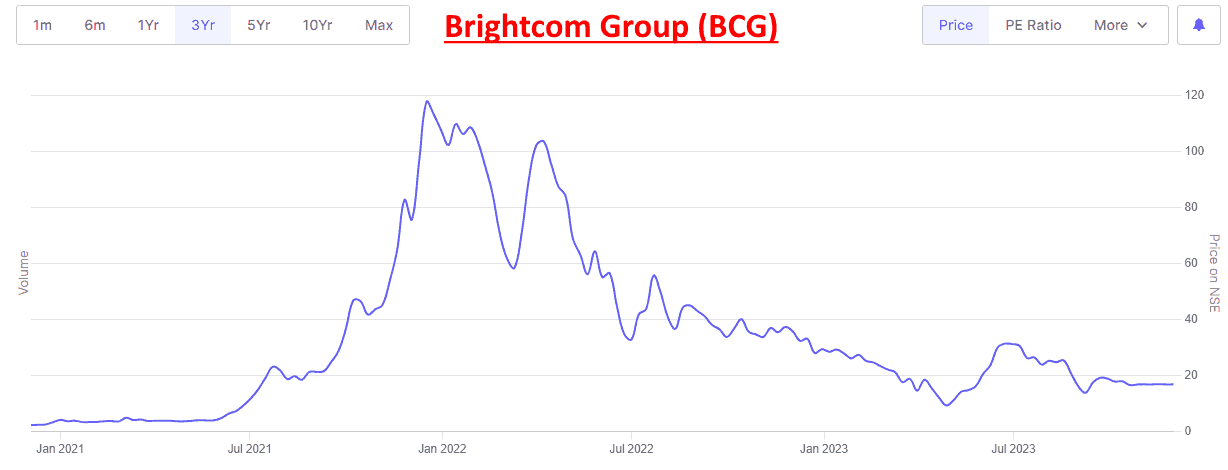
Take, for example, the case of Brightcom Group (BCG), where the stock price increased from ₹3 to ₹4 in April 2021 and by December 2021, the price had exceeded ₹120. Many retail investors put their hard-earned money in the stock to realize their dreams of making quick money. However, it turned out that the entire stock rise was a manipulation. Soon, news of misdeeds by the promoters started coming out in the media, and SEBI issued orders against the promoters and top officials pointing out that they had siphoned off proceeds of preferential allotments raised by the company from stock markets and barring them from directorial posts. No wonder the stock price of BCG crashed from the highs of ₹120 to less than ₹10 and many retail investors suffered heavy losses.
The Real Cost of Greed and Unrealistic Expectations
On social media, just like many people flaunt their investment successes, there are occasions when some investors come out with saddening tales of having lost their hard-earned money in trading due to greed, indiscipline, and taking excessive risk. For example, one trader shared on Twitter (X):
I lost 1.45 lakh in the last 2 days, and it has been very tough for me. I lost whatever I saved and earned in the past 7 months. I was disciplined when I started option trading in the Index, but later, greed, aggressiveness, revenge, and impatience turned out to be my biggest drawbacks and led to my loss.
You also might have come across tragic news reports of investors taking the extreme step of suicide due to losses in stock markets, such as:
- Bengaluru: Stung by stock market losses, Andhra techie commits suicide after killing wife, two daughters, says report
- Rajkot: 25-year-old kills self after losing Rs 60 lakh in stock market
- 20-Year-Old Robinhood Customer Dies By Suicide After Seeing A $730,000 Negative Balance
It is very sad to hear such stories, which reflect that due to greed, irrational expectations, easily available leverage, improper guidance, or any other reason, investors end up taking such investment positions in stock markets that, if they turn against them, leave investors with no other choice than to harm themselves and even their families.
To avoid falling into such traps, an investor needs to understand the basic relationship between risk and return.
Bank Fixed Deposits vs. Equities: Understanding the Risk-Return Rule
An investor should always keep in her mind that for most retail investors, a fixed deposit in a public sector bank is the closest to risk-free returns. Returns on fixed deposits in banks, though they keep on changing over time, are usually in mid-single digits (for example, around 6% to 7% for SBI).
Any expectation of a higher return from any other investment option, such as stocks, real estate, gold, or trading, will come with a higher risk. Only a higher risk provides the probability of a higher return. Investors must keep this simple but most important fact in mind.
Investors enter into the most dangerous mode of investing when they start believing that the strategies they are following with high leverage to make quick returns are without risk. For example, look at headlines and video titles such as:
- How To Earn Safe Money From Options
- The NO-LOSS Option Strategy That Trumps FIXED RETURN Instruments!
- What is the safest strategy in option trading to earn a 4% profit monthly?
Please always keep in mind that anything that promises a higher return than government securities or fixed deposits carries the risk of loss of capital, whether it is explicitly mentioned or not. Otherwise, government securities and bank fixed deposits would lose significance, as everyone would be able to make humongous money from derivatives without any risk. Then why would anyone put money in fixed deposits?
Looking at historical market returns helps keep expectations realistic. If the stock market (Sensex) has given an annualised return of about 13.4% over a 20-year period (Source), then it may not be reasonable to expect doubling money every year, or 5% every month, or 100x in 5 years from stock market investment.
It is said that to finish first in any race, one should first finish the race. Therefore, in investing, finishing the race, that is, surviving or protecting the portfolio until one’s investment horizon, should be the biggest priority for any investor. In this journey to finish the race, having reasonable and rational expectations of returns in line with historical periods, accepting volatility, periods of downturn, and recessions, and keeping a long-term investment horizon are the biggest strengths for any investor.
Why Even Great Companies Like HUL and Reliance Can Stay Flat for a Decade
The desire of investors to make quick and steady money is quite contrary to the way in which businesses generate wealth in the real world and, similarly, the way in which stocks generate wealth in the equity markets. Running a business in the real world is hard, where entrepreneurs have to face many challenges like competition, regulations, and changing customer preferences, among others. The same challenges leave their impact on the returns produced by their stocks. As is the rule in life, nothing comes easy.
Take the example of Hindustan Unilever Ltd (HUL), which is one of the most stable businesses with strong competitive advantages that one can think of. Its products are found in every corner of the country, and almost every person must be using at least one of its products on a daily basis.
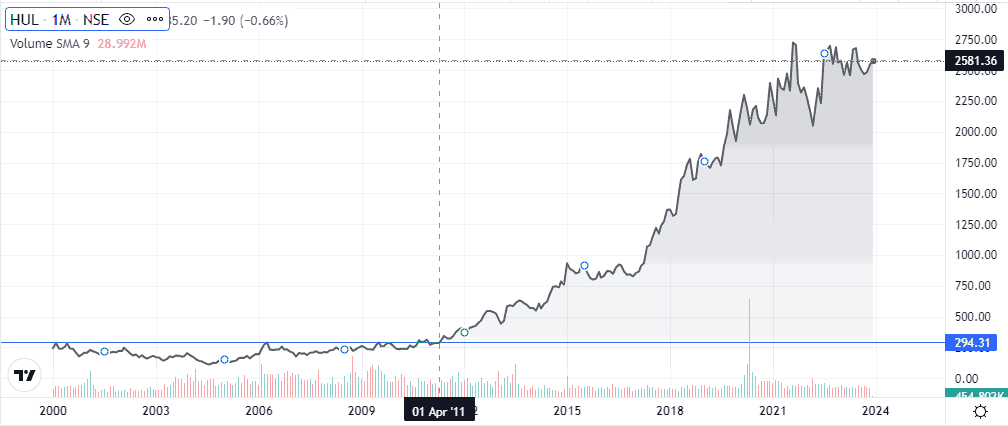
It might seem that if one invests her money in HUL, then she can surely make very good returns. However, a look at the stock price chart of HUL over more than two decades reveals an interesting story. From the year 2000 to April 2011, the stock of HUL hardly gave any return to its investors. And just when even the strongest followers of long-term investing would have given up, its stock started its upward journey, and over the next 12 years (from April 2011 to late 2023), it became more than 8 times its April 2011 price.
HUL is not the only example where investing in a seemingly very strong company did not generate quick and high returns for investors. Let us take the example of another company, which is one of the strongest in the Indian business landscape, Reliance Industries Ltd (RIL). RIL is supposed to be a company which is able to survive and grow under almost every environment, whether political, social, or economic. It is supposed to face challenges head-on and even lobby hard for the removal or changes of restrictive regulations.
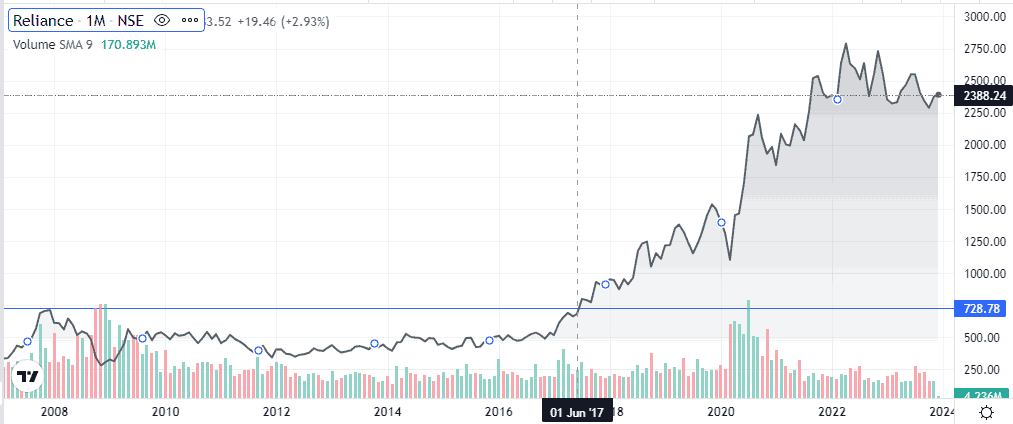
However, if an investor sees the performance of the stock price of RIL over the 15-year period from 2008 to 2023, then she notices that for almost 10 years (2008 to 2017), its stock did not produce any return for its shareholders. Similar to the case of HUL, when almost all long-term investors might have got frustrated by the long wait, its stock started its upward journey and increased to more than 3 times over the next 6 years (from 2017 to 2023).
Looking at the above examples, an investor may note that even by investing in the best of companies with the strongest financial position, competitive advantages, and political influence, it might not be possible to generate a return in the stock market for even up to a decade. Therefore, in stock markets, any expectation or any promise of a consistent, guaranteed return, whether high or low and whether quick or in the long term, is simply not possible.
Stock markets are places of uncertainty. This uncertainty pervades every aspect of a stock and of the underlying business. Whether any strong company’s business will grow or the company will even survive in the future is always uncertain. Promoters’ misdeeds may take down big business empires with them. Sudden wars may shut down entire markets for a company’s products. Sudden pandemics may decimate entire industries. No one knows anything about the future. And in such situations, having fixed expectations of any return from stock markets may not materialize.
Why We Do Not Keep Any Return Expectations or Target Prices
Because of this deep uncertainty, when we invest our money in the stock market, we do not keep any return expectations. There are a few reasons for this, which come directly from our core aim of investing: avoiding a permanent loss of capital:
If we can avoid a permanent loss of capital, then the markets, the companies, and the promoters will take care of the generation of returns in our portfolio. And in this journey, we do not need to worry about bear markets or bull markets or stagnant markets and also temporary down phases in the business performance of companies. In our decades-long investing horizon, multiple such periods will come and go.
We believe that:
- Stocks have the habit of not responding even to good business performance for years altogether, and
- When good stocks rise on recognition by the markets, there is no limit to what extent they may rise.
Even after holding stocks for a long time, when the time to sell comes, the price in the market will be decided by multiple factors like market sentiment. Now, what sentiment would be prevailing at the time of our selling is under no one’s control. It might be an overall euphoria like the peak of January 2008 after a long bull run of 2003 to 2007, or the bottom of March 2009 when the market had declined more than 50% from the peak, or like February and March 2020 (Covid pandemic) when, during a brief period of two months, the markets took away a decade’s worth of investors’ gains.
One thing we as investors can control is which stock to buy and at what price to buy. We believe that a decision to avoid paying an excessive price for buying any stock is one of the best favours that an investor can do for herself. Therefore, we buy any stock only while it is within our preferred buying range and stop buying whenever the price goes beyond our buying range.
After we have bought any stock, the fate of our investment shifts into the market’s hands, where the stock price at any point in time is decided by hundreds of thousands of investors, both individual and institutional, trading in the market. These market participants collectively influence whether a stock will trade at a high or a low price-to-earnings ratio.
Thinking Like a Business Owner and Making Peace with Market Uncertainty
After spending nearly 20 years in stock markets and seeing various boom and bust phases, we believe that expectations from stock investing should be no different from someone running a physical on-ground business.
In on-ground business life, creating a fundamentally strong business that generates a lot of cash without risking bankruptcy associated with excessive leverage is the best way to create wealth. A person running her own business is worried about suffering a permanent loss of her capital without getting paranoid about short-term declines in business. If the on-ground business is growing, then the owner may not be worried about what others think about its valuation. If someone posing as a buyer offers her a lower value for her business, then she may simply ignore such a buyer and focus on running her business.
We apply the same principles in stock investing as well and believe that owning shares of fundamentally sound, cash-generating businesses with low debt should create good wealth for us. In this journey, until the time we believe that the fundamentals of the company are strong, we do not worry about subdued prices. We ignore such buyers. On the contrary, if we have surplus money to invest, then we focus on accumulating more of our stocks, and all this while not getting worried about any minimum return expectations.
The underlying faith is that the entrepreneurs running the on-ground business behind our stocks are working hard to generate wealth for themselves and, in turn, for their shareholders, and we as investors have to just piggyback them.
However, even after selecting good entrepreneurs, uncertainty remains the biggest rule of stock markets. When we decide to invest in stocks, we knowingly or unknowingly expose ourselves to this uncertainty whether we acknowledge it or not. The best approach to make peace with these uncertainties of stock markets is, first, to remove any expectations of fixed returns from our mind and, second, to rely on a process to decide about stocks and then stick to that process. Thereafter, leave everything to God, which in our case is the market.
There will be times when the stock you buy will immediately decline in price leading to large losses. There will be times when the stock you sell will start a long multi-bagger journey leading to huge lost returns. There will be times when the company you thought would perform very well in its business will keep on facing one challenge after another and will frustrate you with unending quarter-after-quarter of suboptimal performance. There will be times when you will assume that now all the challenges are solved and only a smooth journey lies ahead for the company, and then you will realize that new, unthought-of challenges have come up.
All these are the rules of life, and each one of us faces such circumstances in our lives every day, month, and year. Businesses are no different, and stocks are no different.
In such a situation, we believe in investing in fundamentally sound stocks which have strong balance sheets, which give us comfort that these companies will survive the tough times to live another day. And when the business environment becomes favourable, they will have a business standing on the ground to benefit from it.
To conclude, in an uncertain stock market, we request all investors to have reasonable expectations from their investments so that they may avoid the disappointments, negative surprises, emotional turmoil, and impact on personal, social, mental, and family health that unreasonable expectations from stock markets may generate. Having reasonable or better still, no fixed return expectations from your investments will make life and the investing journey much more peaceful.
Key Takeaways for Long-Term Investors
- Guaranteed or quick high returns do not exist in stocks: Any investment promising returns higher than bank fixed deposits or government securities carries a risk of loss of money, whether an investor realises it or not.
- Greed and leverage destroy wealth as well as peace of mind: Expecting fast returns via F&O trading, borrowed money, or low-quality-manipulated stocks can lead to large financial losses and emotional pain for investors.
- Even top companies’ share price can stay flat for a decade: Stocks of strong businesses like Hindustan Unilever (2000 to 2011) and Reliance Industries (2008 to 2017) gave nearly zero returns for nearly 10 years before turning into multi-bagger profits.
- Focus on what you can control: Investors cannot predict or control future market sentiment or return timelines. They can only control which company they invest in e.g. fundamentally strong, low-debt companies with shareholder-friendly promoters and avoid overpaying when buying.
- Survive first and think like a business owner: Investors should avoid fixed return expectations, and focus on avoiding permanent loss of capital by following a disciplined investing process.
Regards,
Dr Vijay Malik
P.S.
- Subscribe to Dr Vijay Malik’s Recommended Stocks: Click here
- Bengaluru “Peaceful Investing” Workshop | 31 Jan 2027: Register Here
- To learn stock investing through videos, you may subscribe to the Peaceful Investing – Workshop Videos
- 25% savings on buying our Stock Analysis Excel Template and all ebooks together: Analysis Package: Excel Template + All eBooks (25% savings)
- To download our customized Stock Analysis Excel Template for analysing companies: Stock Analysis Excel
- Learn about our stock analysis approach in the e-book: “Peaceful Investing – A Simple Guide to Hassle-free Stock Investing”
- To learn how to do business analysis of companies: e-book: Business Analysis Guide
- To pre-register/express interest in a “Peaceful Investing” workshop in your city: Click here
Disclaimer
I, Vijay Malik, am a SEBI-registered Research Analyst (Regn. No. INH100008364). This article is for educational purposes only and does not constitute investment advice or a recommendation to buy or sell any securities. Investors should do their own research before making any investment decisions.
I, or my immediate relatives, do not have any financial interest in the companies discussed as on the date of publication of this article, nor do we hold one per cent or more of the securities of such companies at the end of the month immediately preceding it. I do not have any material conflict of interest and have not received any compensation or other benefits from the companies or any third party in relation to this article during the 12 months preceding its publication. I have not served as an officer, director, or employee of the subject companies, nor have I been engaged in market making activity for them.