Eris Lifesciences Ltd is an Indian pharmaceutical company primarily focused on the domestic branded formulations market. The company mainly deals in chronic and sub-chronic therapeutic areas such as diabetes, cardiac care, and dermatology. It relies heavily on prescriptions from medical specialists and super-specialists primarily in tier 1 cities.
In recent years, Eris Lifesciences Ltd has attracted strong investor interest because of higher-than-peers profit margins, steady revenue growth, and multiple acquisitions, including Oaknet Healthcare; dermatology brands from Glenmark and Dr. Reddy’s; Biocon’s domestic formulations business; and Swiss Parenterals.
However, our experience shows that during periods of rapid growth, investors often overlook critical risks. In this article, rather than offering a buy or sell recommendation, we examine the fundamental business risks, regulatory challenges, debt-funded expansion, and corporate governance practices of Eris Lifesciences Ltd that long-term investors should consider before forming an opinion.
Key risks for long-term investors in Eris Lifesciences Ltd
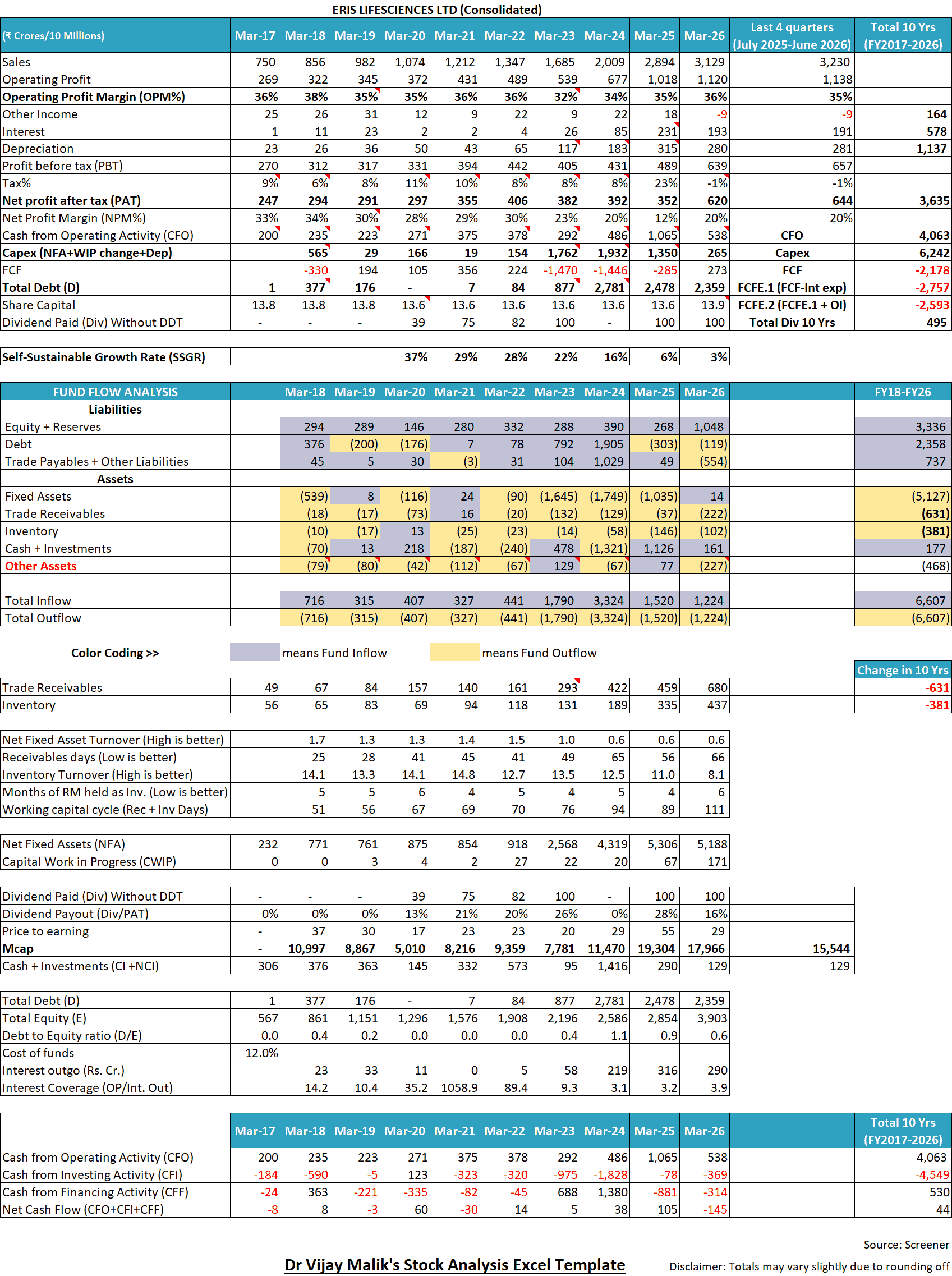
A snapshot of the financial performance of Eris Lifesciences Ltd over the last 10 years is provided below to give you the context for the discussion that follows:
1. High Margins and the Fragile Power of Doctor Prescriptions
Eris Lifesciences Ltd has consistently reported a superior performance than many of its domestic pharmaceutical peers. While traditional formulation companies often operate with operating profit margins in the low-to-mid 20% range, Eris Lifesciences Ltd has historically delivered operating margins between 33% and 36%, alongside consolidated gross margins around 75% to 82%.
A key reason for these high margins is the market segment targeted by the company. In its Red Herring Prospectus (RHP, Pages 44 and 46) filed during its initial public offer (IPO) in 2017, Eris Lifesciences Ltd clarified that its business focuses on chronic and sub-chronic lifestyle diseases, primarily targeting medical specialists and super-specialists such as cardiologists, diabetologists, and endocrinologists. Specialist doctors gain a high level of trust from patients, which allows the prescription drugs recommended by such doctors to sell at premium prices.
Credit rating agencies like India Ratings have highlighted this feature of Eris Lifesciences Ltd. For instance, in its Credit Rating report (CR) dated May 8, 2026, India Ratings observed:
ELL has one of the highest gross margins and EBITDA margins among Indian pharmaceutical players, given its higher share of DF revenues.
However, an investor should look beyond the reported numbers to understand whether this pricing power is sustainable.
1.1 Brand loyalty of generic drugs depends entirely on doctors, not patients
The profitability of Eris Lifesciences Ltd is not due to any patented new chemical drugs discovered in-house. Instead, the company sells off-patent generic medicines by creating its own brand names. In this segment, medicines made by different companies contain the exact same drug.
Normally, a patient rarely chooses which brand of medicine to buy. The patient buys whatever brand the doctor writes on the prescription. This is truer for chronic patients with diabetes and heart conditions who develop a strong faith in their specialist doctors and are willing to pay premium prices for prescribed brands.
The single biggest risk to this business model is if patients realise that unbranded generic medicines, or cheaper branded drugs containing the exact same salt, provide the same relief. Or, if doctors stop prescribing specific brand names, then the patients will buy lower-cost drugs. This will take away the pricing power of branded formulation companies.
The government in India has recognised this issue and has taken some steps in its attempts to break the link between doctors’ prescriptions and high medicine costs. In October 2016 and April 2017, the Medical Council of India (MCI) issued notifications asking that medical practitioners prescribe medicines using their generic chemical names rather than commercial brand names (RHP, P23). Eris Lifesciences Ltd acknowledged this in its Annual Report (AR) for FY2017, page 50:
THREATS: Industries high reliance on the branded products in the chronic category may be a cause of concern considering government’s generic push.
Additionally, regulators and courts have also pointed out the commercial arrangements between pharmaceutical companies and medical practitioners. The Uniform Code of Pharmaceutical Marketing Practices (UCPMP) aims to stop companies from offering gifts, travel sponsorships, or monetary incentives to doctors to write their drugs in prescriptions.
In its RHP (P20), Eris Lifesciences Ltd disclosed that an anonymous complaint was previously submitted to the Department of Pharmaceuticals alleging that the company had provided benefits to doctors, such as travel expenses and medical conference registrations.
More recently, the Supreme Court of India directed the central government to form a panel to inspect the issue of pharmaceutical companies giving incentives to doctors for prescribing their drugs (Source: Moneylife, 8 Oct 2026).
Competition Commission of India (CCI) has also highlighted the artificial nature of brand premiums in generic medicines. In its market study on the pharmaceutical sector, the CCI observed that branded formulation players often create an illusion of superior quality to charge higher prices, even when different companies get their medicines made from the same third-party contract manufacturers.
A look at the spending pattern by Eris Lifesciences Ltd confirms its focus. In FY2026, the company spent ₹26 crore on research and development (AR2026, P349), which represents less than 1% of its operating revenue of ₹3,129 cr.
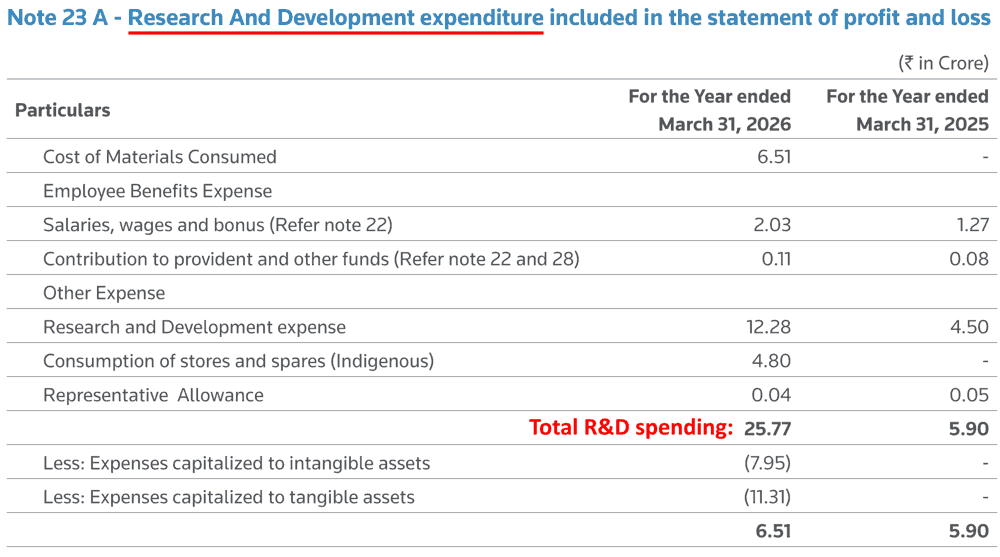
In contrast, the company spent over 12% (₹375 cr) of its revenue on commissions, advertising, selling and distribution expenses, representative allowances, and travel costs (AR2026, P348).
This large difference shows that the business relies heavily on extensive field marketing and doctor engagement rather than laboratory research. If government rules strictly enforce generic-name prescriptions, this marketing advantage of Eris Lifesciences Ltd will be hurt substantially.
Also read: How to do Business Analysis of Pharmaceutical Companies
1.2 Price controls, margin caps, and slowing growth in core segments
Price control of essential medicines poses another challenge to the profit margins of Eris Lifesciences Ltd. The central government regulates medicine prices through the National List of Essential Medicines (NLEM) under the Drugs (Prices Control) Order (DPCO), administered by the National Pharmaceutical Pricing Authority (NPPA).
Historically, Eris Lifesciences Ltd maintained a low exposure to price-controlled drugs, with NLEM drugs accounting for just 7% of revenue in FY2021 (AR2021, P14). However, as the government continues to bring newer drugs such as teneligliptin and glimepiride under price controls, the company’s NLEM exposure increased to 17% of total revenue by March 31, 2026 (AR2026, P67).
Over the years, the company has faced regulatory actions for selling drugs above government-notified price ceilings. In its RHP (P24 and P262), Eris Lifesciences Ltd reported receiving show-cause and demand notices from the NPPA for alleged overcharging on drugs such as Cyblex, Atorsave-10, Superclop, and Enoxsave. The NPPA also issued notices that the company altered dosages and launched fixed-dose combinations without prior price approval, including Glimisave Debut M, Glimisave Max, and Cyblex MV.
In addition to increasing the NLEM list, the Supreme Court of India has recently directed authorities to consider putting a cap on trade margins across all essential medicines and medical devices. (Source: The Hindu, 17 Oct 2026). Implementing such caps on distribution margins would directly impact the cushion that branded formulation companies use to reward various intermediaries.
Additionally, the rise of e-pharmacies (like Tata 1mg) and organised retail pharmacy chains (like Apollo Pharmacy), offering discounts, has squeezed the profit margins of traditional retail chemists. To help its distributors handle this pressure, Eris Lifesciences Ltd had to relax its credit terms in metropolitan markets from 7 to 14 days, up to 21 days (Concall November 2019).
When competition limits pricing flexibility, a company must rely on volume expansion to show growth. However, disclosures in recent annual reports show that many established therapy segments of Eris Lifesciences Ltd have struggled to keep pace with industry growth rates.
In FY2026, the company reported that its Vitamins, Minerals, and Nutrients (VMN) segment underperformed the industry growth rate (AR2026, P40). Its Central Nervous System (CNS) division and Critical Care portfolio also lagged market growth rates, while the Nephrology division declined by 14% (AR2026, P43, P44, and P45). Many of its established brands, like Glimisave, Eritel, and Zomelis, recorded revenue declines (AR2025, P74; AR2026, P32).
This underperformance extended into early FY2027. In the quarterly results for Q1-FY2027, Eris Lifesciences Ltd reported that its oral anti-diabetic (OAD) segment grew by only 1.9% compared to 11.5% for the industry. Its cardiac portfolio grew by 11.1% against 16.9% for the market, and its CNS division expanded by 5.8% compared to the industry rate of 12.9%. In the conference call held on July 29, 2026, pages 2-3, management acknowledged the issue in its core chronic segments:
Amit Bakshi: We have been trailing in Hypertension… largely two products which we are kind of getting on track.
As core therapies slow down and govt limits its pricing freedom, maintaining premium margins will become difficult. An investor studying the company must realise that high profit margins built on specialist prescriptions face a risk whenever govt takes steps like price controls or forces doctors to prescribe generic drug names.
Also read: How to do Business Analysis of Any Company
2. “R&D” of Eris Lifesciences Ltd Focuses on Drug Combinations Rather Than New Medicines
At Eris Lifesciences Ltd, R&D does not focus on discovering new drugs. Instead, it focuses on combining two or more existing, off-patent drugs into a single tablet, known as a fixed-dose combination (FDC), or creating new dosage forms. While this strategy helps in launching new product variants quickly, it also exposes the company to regulatory risks.
2.1 Spending money on Fixed-Dose Combinations (FDCs) instead of real research
A close look at the financial statements shows that Eris Lifesciences Ltd spends very little money on R&D. In FY2026, Eris Lifesciences Ltd spent ₹26 crore on R&D (AR2026, P349), which is less than 1% of its total revenue. Whereas it spent hundreds of crores, representing more than 12% of its sales, on selling, marketing, travel, and representative allowances (AR2026, P348).
Management has clearly acknowledged this approach to analysts. In the conference call held in July 2021 (P14), the management clarified the scope of its R&D:
V. Krishnakumar: When we say R&D, we don’t mean drug discovery or basic research or API synthesis.
These drug combinations do not enjoy any multi-year patent exclusivity. The management noted in the conference call of August 2023 that being first to market with an FDC only provides a temporary head start of three to six months before competitors launch identical copies.
Regulators often see these combinations as marketing gimmicks to command premium pricing and bypass price controls on individual drugs. Repeatedly, government committees have said that many of the fixed-dose combinations in the Indian market lack any medicinal benefits. As a result, govt frequently bans drug combinations. (Source: They lack therapeutic justification: Centre bans 16 fixed-dose combination drugs: India Today)
2.2 How government bans on drug combinations hurt sales
Because a significant part of product development of Eris Lifesciences Ltd relies on Fixed-Dose Combinations, government bans on FDCs are a significant risk for the company.
In 2018, the central government banned several FDCs, which forced Eris Lifesciences Ltd to withdraw its popular anti-diabetic drug, Triglimisave LS. In the conference call in May 2019, management reported that the discontinuation of this single product wiped out approximately ₹20 crore of sales in FY2019.
In FY2026, the government banned another drug combination of Eris Lifesciences Ltd, Glimisave MV 2.3. The company highlighted that it led to a loss of ₹40 cr in sales in its FY2026 Annual Report, page 14:
Our OHA business took a revenue loss of ~ Rs. 40+ crore during the year due to the ban on a significant FDC (Glimisave MV 2.3)
As a result, in Q1-FY2027, the oral anti-diabetic (OAD) division recorded a growth rate of only 1.9% compared to 11.5% for the industry.
In addition, Eris Lifesciences Ltd had to abandon product launches and faced project delays due to regulatory approvals and reliance on third-party product development. In FY2026, regulatory delays forced the company to cancel its launch of gSaxenda (a Liraglutide formulation for weight management), whereas it had to defer launches of Insulin Aspart and the blood-pressure drug Esaxerenone. Management said that these issues caused a revenue loss of ₹55 crore to ₹60 crore (Concall May 2026).
These episodes demonstrate that just combining generic drugs into combinations may not provide durable competitive advantage. When a company’s R&D relies on combinations that only offer convenience instead of medical necessity, the entire product line can be eliminated by a single regulatory action (stroke-of-pen risk).
Also read: How to analyse New Companies in Unknown Industries?
3. Sudden Shifts in Strategy by Eris Lifesciences Ltd and New Export Headwinds
3.1 Moving from a safe domestic market to risky exports
For many years after its listing, Eris Lifesciences Ltd positioned itself as a pure-play domestic formulations company. Management said that the domestic market provided large expansion opportunities without the regulatory headaches and price erosion of international markets. In the conference call held in July 2021 (P5), management stressed this approach:
V. Krishnakumar:…there is no plan to get into exports… there is so much to be done in India and we will have our hands full with that.
However, this strategy changed significantly in February 2024 when Eris Lifesciences Ltd acquired a majority stake in Swiss Parenterals Ltd. Swiss Parenterals had a business model almost 100% focused on exports (India Ratings report dated February 22, 2024).
Following this acquisition, Eris Lifesciences Ltd officially changed its shareholders’ communications. In its FY2025 Annual Report (AR2025, P16 and P48), the company announced that it was evolving from an “India-only” business to an “India + RoW Exports” business. The management also disclosed plans to have its Ahmedabad manufacturing facility inspected by foreign regulatory authorities to export oral solid doses (Concall May 2024).
This shift introduces a major change to the company’s business model. In the Indian market, Eris Lifesciences Ltd earns high margins because its large sales force convinces specialist doctors to prescribe its brands. In international export markets, doctor relationships do not exist. Instead, regulatory dossiers, distributor contracts, and low production costs provide competitive advantages.
Direct competition with much larger generic pharmaceutical manufacturers purely on price would hurt the profit margins of Eris Lifesciences Ltd. In addition, international sales are subject to geopolitical disruptions. For example, in Q4-FY2026, the company missed its international quarterly shipment targets by about ₹30 crore due to logistics disruptions linked to conflict in the Middle East (Concall May 2026).
3.2 Failed plant inspections and changing stances on acquisitions
Entering export markets also exposes a company to stringent regulatory inspections by foreign drug inspectors. Eris Lifesciences Ltd faced almost no regulatory disruption when it manufactured only for the domestic market. However, its international facilities soon faced compliance issues.
In April 2026, the Croatian health agency, Halmed, inspected the two injectable manufacturing facilities of Swiss Parenterals Ltd in Gujarat. Both the units failed the inspection. Even though the management described these observations as procedural, they disrupted the company’s contract development and manufacturing (CDMO) plans for the European Union. In the conference call of May 2026 (P14), management acknowledged a loss of revenue opportunity of ₹120-140 cr in FY2027 due to inspection failure:
V. Krishnakumar: …we had cancelled about INR 120 crores to INR 140 crores of revenue coming in from the EU CDMO from our FY27 guidance
The impact of these operational and shipment delays was visible in Q1-FY2027, where operating profit (EBITDA) for the international division dropped by 19% (Q1-FY2027 Results Presentation, P10).
A similar shifting stance is visible in the company’s approach to corporate acquisitions. In the conference call of May 2018, management stated that small acquisitions required the same administrative effort as large ones, and declared that it would avoid purchasing small assets.
However, later, the company did many small deals, like acquiring Velbiom Probiotics’ brand portfolio for ₹50 crore in March 2026, acquiring Chemman Labs for ₹105 crore, and buying a 30% stake in Levim Lifetech for ₹54 crore (India Ratings reports of May 5, 2025 and May 8, 2026).
Then, in July 2026, management reversed its position on deal-making altogether, stating that it was stopping acquisitions to focus on operationalising its manufacturing units (Concall July 2026).
Similarly, management mentioned in the August 2020 conference call that it was actively considering backward integration into APIs to secure its supplies; however, no meaningful API production has been established until now.
When management shifts between being an India-only player and an exporter, continually changes its acquisition criteria and does not execute essential supply protection plans, its business model becomes less predictable.
Also read: How to Identify if Management is Misallocating Capital
4. Buying Growth Through Debt and the Strain on Operations
When a company struggles to generate high volume growth in its core products, it often turns to acquisitions, which allow the company to show immediate growth.
However, when these acquisitions are funded by large amounts of debt, the business and financial risk increases significantly. If the acquired assets fail to generate expected cash, the fixed debt payments can quickly create liquidity stress.
4.1 Funding rapid acquisitions with heavy debt and pledged shares
In the years following its initial public offer in 2017, Eris Lifesciences Ltd maintained a conservative balance sheet. The company kept a debt-free status and funded its capital expenditure from its internal cash flows.
However, this approach changed completely after FY2022. Facing slowing growth across its legacy oral diabetes and cardiovascular segments, Eris Lifesciences Ltd launched an aggressive acquisition run, using large amounts of borrowed money to purchase pharma brands and manufacturing plants.
Between FY2023 and FY2026, the company used more than ₹4,300 crore toward corporate acquisitions (Investor Presentation, June 2026, P5).
- In May 2022, Eris Lifesciences Ltd entered the dermatology segment by acquiring Oaknet Healthcare Pvt Ltd for ₹650 crore, using debt of ₹350 crore (AR2022, P16)
- In January 2023, the company acquired nine dermatology brands from Glenmark Pharmaceuticals for ₹340 crore. Just two months later, in March 2023, it purchased nine cosmetic dermatology brands from Dr. Reddy’s Laboratories for ₹275 crore. Both these transactions were funded entirely through debt (AR2023, P19).
- In November 2023, Eris Lifesciences Ltd acquired Biocon Limited’s nephrology and dermatology portfolios for ₹366 crore, taking on an additional ₹280 crore of debt (Concall November 2023).
- In February and April 2024, it bought a 70% stake in Swiss Parenterals Ltd for ₹875 crore, which was also funded by debt (AR2024, P70).
- In April 2024, the company did its largest acquisition, the Indian branded formulations business of Biocon Biologics Limited for ₹1,242 crore, funded through debt of ₹975 cr (CR2024 by India Ratings, May 28, 2024).
- In Q1-FY2025, Eris Lifesciences Ltd acquired Chemman Labs Pvt Ltd for its Bhopal insulin manufacturing facility for ₹105 crore
- In Q3-FY2025, it acquired a 30% stake in Levim Lifetech for ₹54 crore, and
- In March 2026, it purchased the branded probiotics business of Velbiom Probiotics Pvt Ltd for ₹50 crore in March 2026 (India Ratings reports, May 5, 2025 and May 8, 2026).
This rapid series of acquisitions completely changed the balance sheet of Eris Lifesciences Ltd. Its consolidated debt increased from zero in March 2022 to approximately ₹2,359 crore by FY2026.
Furthermore, on 30 Sept 2026, a 21.25% stake of promoters is pledged with lenders (Source: BSE). An investor may contact the company directly to understand whether these shares are pledged by promoters in favour of lenders for loans taken by the company, to give higher confidence to lenders, or it is for personal purposes.
When an investor analyses such fast expansion by acquisitions, she must understand that such growth comes with a high financial risk. In such a situation, any disruption in operations immediately affects the financial health of the acquiring entity.
4.2 Supply shortages, lower margins, and cash stuck in working capital
Most of the time, companies face challenges in integrating newly acquired companies to derive synergies. In the case of Eris Lifesciences Ltd as well, the company faced product write-offs, trade channel restructuring, and supply shortages.
After purchasing Kinedex Healthcare, the acquired business suffered a sales degrowth of 30% in Q3-FY2019 due to inventory corrections and regulatory changes by the food safety authority (Concall January 2019).
Another acquired company, Aprica Healthcare Ltd, suffered significant losses, and Eris Lifesciences Ltd had recognised an impairment of goodwill of ₹76.81 crore (AR2023, P180 and P256).
Similarly, after buying the domestic portfolio of Strides Shasun, the company had to discontinue about ₹40 crore of low-margin brands and completely shut down its hormone division (Concall January 2021 and July 2021).
Eris Lifesciences Ltd faced the most significant challenges after entering into insulins and biologics. It entered the insulin segment through a joint venture (JV) with MJ Biopharm, but immediately faced shortages and had an operating loss of ₹20 crore in FY2023 (AR2023, P17). Even after acquiring insulin brands of Biocon, it remained dependent on third-party manufacturers that could not meet demand, leading to missed substantial sales opportunities.
In its FY2026 Annual Report, page 14, Eris Lifesciences Ltd disclosed the significant impact of more than ₹100 cr due to these supply problems:
Over the past two years, supply constraints from third-party manufacturers had resulted in a revenue loss of Rs. 100+ crore in insulins alone.
Moreover, these new businesses diluted its profit margins. The insulin portfolios and Swiss Parenterals injectables had lower margins. As a result, the consolidated gross margin of Eris Lifesciences Ltd fell from 84% in FY2020 to 75.3% in FY2025 and 75% in FY2026 (AR2025, P89; AR2026, P64).
Additionally, the acquired Critical Care portfolio from Biocon had such low margins that management had to reduce the business size by 20% to reduce losses (Concall May 2025).
The acquisitions have also stretched the working capital cycle. Selling institutional injectables, insulins, and hospital supplies needed longer credit terms than traditional distribution of the company. As a result, consolidated receivable days of the company increased from 25 days in FY2018 to 66 days in FY2026. Increased working capital intensity led to substantial amounts of cash getting tied up in inventories, supplier advances, and delayed customer payments (Concall February 2026).
While analysing a company that is doing multiple acquisitions, an investor should check whether the new business is generating free cash flow. If debt-funded acquisitions reduce profit margins, increase the working capital cycle, and create supply chain problems, then it impacts the strength in the business model of the company.
Also read: Receivable Days: A Complete Guide
5. Corporate Governance Lapses and Related Party Transactions
Over the years, corporate filings of Eris Lifesciences Ltd show repeated secretarial delays, board composition lapses, transactions with promoter-linked entities, and political donations that need careful analysis.
5.1 Fines from stock exchanges for delayed director appointments
Eris Lifesciences Ltd has multiple times delayed board appointments and statutory reporting. In FY2021, the company delayed filing its related party transaction disclosures with stock exchanges by 11 days. During the same financial year, it delayed appointing new independent directors by 25 days, and failed to keep a minimum of six board directors for a period of eight days. As a result, Eris Lifesciences Ltd had to pay fines to stock exchanges (AR2021, P75).
The company repeated the issue of board composition in FY2026. After the end of the tenure of an independent director in December 2025, the company did not fill the vacancy for about three months. The company acknowledged the delay in its FY2026 Annual Report, page 83:
term of Mr. Rajeev Dalal as an Independent Director of the Company expired on 18th December, 2025…Company appointed new Independent Director with effect from 14th March 2026 resulting in a delay of 85 days
For this noncompliance, both BSE and the National Stock Exchange of India (NSE) imposed fines of ₹4,25,000 + GST each on Eris Lifesciences Ltd (AR2026, P116).
Corporate governance issues are present in the subsidiaries as well. After acquisition, Swiss Parenterals Ltd did not appoint the required number of independent directors to its board. As a result, its board committees like the Audit Committee, Nomination and Remuneration Committee, and Corporate Social Responsibility Committee did not meet regulatory requirements (AR2026, P88 and P89).
When an investor notices repeated corporate governance issues in any company, then she should increase her depth of due diligence.
5.2 Large sales to promoter-owned entities and political donations
An investor should be careful when analysing transactions between a listed company and its promoter-owned entities because such related party transactions have the potential to shift economic benefits from public shareholders to promoters.
During the acquisition of Swiss Parenterals Ltd (SPL) in February 2024, Eris Lifesciences Ltd acquired a 51% stake in SPL for ₹637.5 crore. At the same time, the promoters of Eris Lifesciences Ltd acquired a 19% stake in SPL for ₹237.5 crore.
However, just a few months later, in April 2024, Eris Lifesciences Ltd raised long-term debt through non-convertible debentures and used it to buy out the 19% stake of SPL held by its own promoters for ₹237.5 crore. In its credit rating report dated May 28, 2024, India Ratings highlighted this arrangement:
The NCD proceeds will also be used to pay INR2,375 million to its promoters against the 19% stake acquired in SPL.
Such transactions raise many questions. If Eris Lifesciences Ltd wanted to buy 70% of Swiss Parenterals, then why did the promoters purchase the 19% stake in their personal capacity only to sell it to the listed company months later using debt raised by the firm? In such transactions, there is always a risk of some undisclosed arrangements between different counterparties, which increase the perceived risk in the minds of investors.
In addition, in FY2024, Eris Lifesciences Ltd sold goods amounting to ₹95 crore to promoter-owned related parties. In FY2025, these sales increased to ₹120 cr (AR2025, P375).
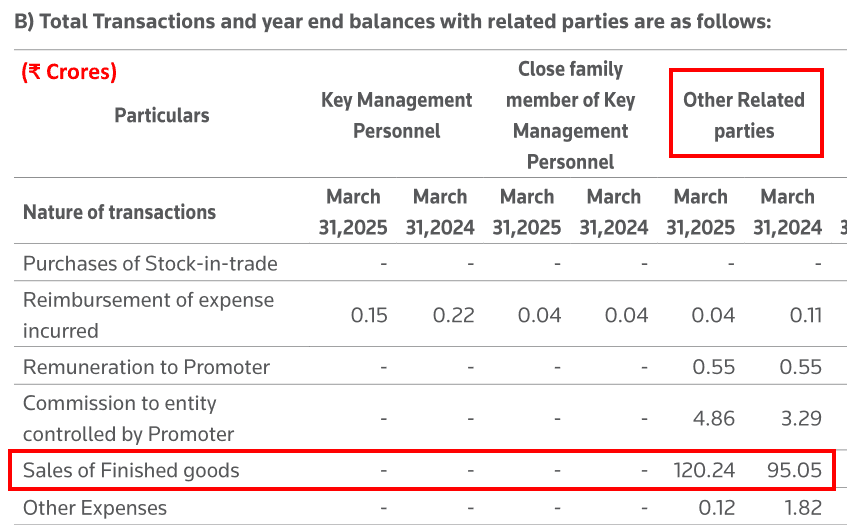
When a company sells a large amount of goods to promoter-controlled entities, then an investor should do an in-depth analysis to understand whether these sales are in line with market prices and terms. This is because any preferential terms, such as price or credit terms, have the potential to shift economic benefit from public shareholders to promoters.
In FY2024, Eris Lifesciences Ltd spent ₹15 crore on donations, compared to just ₹80,000 in FY2023. As per the FY2024 annual report, this ₹15 crore donation was made to the Bharatiya Janata Party (AR2024, P312). An investor should note that making donations to any particular political party exposes a company to political risks.
An investor should always look beyond reported profits and focus on corporate governance practices of any company. She should closely analyse circular equity transactions and related party transactions with promoters, as well as large political donations, while assessing long-term investment risks.
Also read: How Promoters benefit from Related Party Transactions
Conclusion: Final thoughts for long-term investors
The analysis of Eris Lifesciences Ltd shows how superior-than-peers profit margins and fast revenue growth can hide business and regulatory risks. While the company seems to have established a strong presence in chronic segments, a deeper analysis shows that its earning power faces many challenges.
The main competitive advantage (moat) of Eris Lifesciences Ltd is not any innovative drug discovery, but its marketing relationships with specialist doctors who prescribe its generic brands. These branded generics contain off-patent drugs and do not offer any superiority over other identical, lower-cost medicines.
Chronic patients buy generic brands at premium prices due to their trust in the doctors. Efforts by the government and judiciary to push doctors to write generic names on prescriptions, limit trade margins, and stop incentives from pharmaceutical companies to doctors present a significant risk to the arrangements between doctors and pharma companies.
If patients gain confidence in low-cost unbranded generics or if doctors are forced to write only the salt name in their prescriptions, the pricing power of Eris Lifesciences Ltd will face a strong impact.
Spending by Eris Lifesciences Ltd of less than 1% of revenue on research and over 12% on selling and doctor-engagement expenses clearly shows its priorities. Its R&D focusing only on making new fixed-dose drug combinations (FDCs) provides only a short-term advantage and frequently exposes it to regulatory bans on non-essential FDCs. Such bans have caused significant revenue losses in its core anti-diabetic segment.
Eris Lifesciences Ltd has shown strategic inconsistency in multiple aspects. It abandoned its “India-only” strategy and acquired export-oriented businesses like Swiss Parenterals, which has exposed it to stringent foreign regulatory inspections and global price competition, where doctor relationships do not offer any pricing power. Recent instances of failed inspections and resultant delays in European CDMO business show the risks of business disruptions in targeting developed markets.
In addition, a change in management strategy from maintaining a strong zero-debt balance sheet to rapid, large debt-funded acquisitions has significantly increased financial risk in the company. In recent years, Eris Lifesciences Ltd has spent more than ₹4,300 crore on acquisitions and has increased its debt from zero to more than ₹2,300 crore. Promoters have also pledged a significant stake to lenders. These developments reduce the margin of safety in the business model.
We believe that an investor should look beyond the reported revenue growth and profit margin numbers and focus on underlying business and regulatory risks, quality of capital allocation, and corporate governance standards, including related party arrangements.
In our premium services, this kind of analysis is used primarily as a filtering tool to eliminate businesses where long-term risks outweigh the benefits of growth. Only companies that demonstrate sustainable cash flows, prudent capital allocation, and aligned promoter incentives eventually qualify for inclusion in my long-term portfolio.
Regards,
Dr Vijay Malik
P.S.
- Subscribe to Dr Vijay Malik’s Recommended Stocks: Click here
- Bengaluru “Peaceful Investing” Workshop | 31 Jan 2027: Register Here
- To learn stock investing through videos, you may subscribe to the Peaceful Investing – Workshop Videos
- 25% savings on buying our Stock Analysis Excel Template and all ebooks together: Analysis Package: Excel Template + All eBooks (25% savings)
- To download our customized Stock Analysis Excel Template for analysing companies: Stock Analysis Excel
- Learn about our stock analysis approach in the e-book: “Peaceful Investing – A Simple Guide to Hassle-free Stock Investing”
- To learn how to do business analysis of companies: e-book: Business Analysis Guide
- To pre-register/express interest in a “Peaceful Investing” workshop in your city: Click here
Disclaimer
I, Vijay Malik, am a SEBI-registered Research Analyst (Regn. No. INH100008364). This article is for educational purposes only and does not constitute investment advice or a recommendation to buy or sell any securities. Investors should do their own research before making any investment decisions.
I, or my immediate relatives, do not have any financial interest in the companies discussed as on the date of publication of this article, nor do we hold one per cent or more of the securities of such companies at the end of the month immediately preceding it. I do not have any material conflict of interest and have not received any compensation or other benefits from the companies or any third party in relation to this article during the 12 months preceding its publication. I have not served as an officer, director, or employee of the subject companies, nor have I been engaged in market making activity for them.